Sunday, October 19, 2008

What the dead know

Have you ever heard of a photo essay being cited in a presidential race? Well, Colin Powell did it this morning on Meet the Press.

Powell, the former Secretary of State who lost street cred when he stumped for the Bush Doctrine at the UN, said that he was moved by an image in a recent photo essay depicting a mother at the grave of her soldier son. The point, Powell said, is that the son -- who was 20 when he died in service of his country -- was a Muslim, something his party has suggested is unpatriotic.

"I feel strongly about this particular point because of a picture I saw in a magazine," Powell said, referring to the Sept. 29 issue of The New Yorker. "It was a photo essay about troops who are serving in Iraq and Afghanistan. And one picture at the tail end of this photo essay was of a mother in Arlington Cemetery, and she had her head on the headstone of her son's grave."

The photo essay is by 40-year-old New York photographer Platon (yes, he is professionally known only by his first name). Fifteen years ago, British Vogue named him the best up-and-coming photographer.

"You could see the writing on the headstone," Powell said. "And it gave his awards--Purple Heart, Bronze Star--showed that he died in Iraq, gave his date of birth, date of death. He was 20 years old. And then, at the very top of the headstone, it didn't have a Christian cross, it didn't have the Star of David, it had crescent and a star of the Islamic faith. And his name was Kareem Rashad Sultan Khan, and he was an American. He was born in New Jersey. He was 14 years old at the time of 9/11, and he waited until he can go serve his country, and he gave his life. Now, we have got to stop polarizing ourself in this way."

Friday, October 17, 2008

The Texan

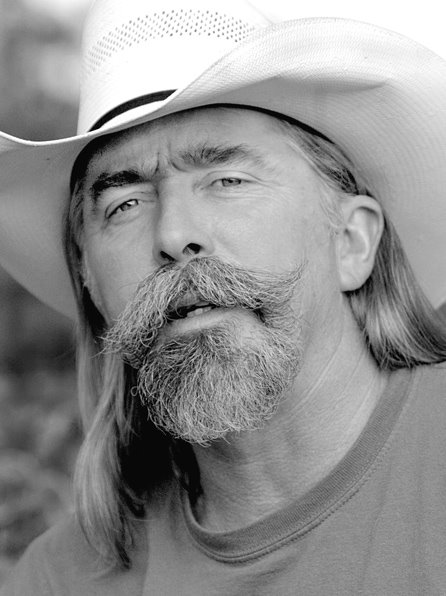
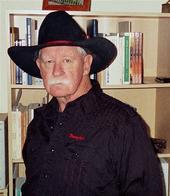
The Ozark Creative Writers' annual conference was last weekend at Eureka Springs, Arkansas, and I had a chance to make a portrait of my friend, Mike Blakely. He's a singer, songwriter, and of course a native Texan.

Wednesday, October 15, 2008

Extra money is always helpful

Here's a lead from today's New York Times that I had to read three times.

WASHINGTON — The chief executives of the nine largest banks in the United States trooped into a gilded conference room at the Treasury Department at 3 p.m. Monday. To their astonishment, they were each handed a one-page document that said they agreed to sell shares to the government, then Treasury Secretary Henry M. Paulson Jr. said they must sign it before they left.

There was no press at this invitation-only meeting, but Mark Landler and Eric Dash did an admirable job of recreating it from interviews. It was, in short, a $250 billion offer the banks couldn't refuse.

Even as they insisted that they did not need the money, bankers recognized that the extra capital could be helpful if the economy became shakier. Besides, many of these banks’ biggest businesses are tied to the stock and credit markets; the quicker they improve, the better their results.

This is just obscene.
Like guns and cars, cameras are fantasy-machines whose use is addictive. However, despite the extravagances of ordinary language and advertising, they are not lethal. In the hyperbole that markets cars like guns, there is at least this much truth: except in wartime, cars kill more people than guns do. The camera/gun does not kill, so the ominous metaphor seems to be all bluff - like a man's fantasy of having a gun, knife, or tool between his legs. -- Susan Sontag, On Photography, 1977

Wednesday, October 8, 2008

Wake me when it's over

National Newspaper Week is here. I almost missed it.

The theme this year is "Public Notice: Good Government on Display" and the Newspaper Association Managers (NAM on second reference) have offered a downloadable press kit. The aim of the editorials and cartoons and crossword is that it's important for government to keep running paid legal notices in newspapers because, well, it's oh so much better than the free Internet.

"Why in the world should governmental entities spend taxpayers’ money on public notices when they can post them on the Internet for next to nothing?" gushes one canned editorial. "Because the taxpayers have a right to know, have a need to know and want to know, that’s why. The argument is as simple as that."

Not sure I can get worked up about a campaign aimed at convincing local governments keep buying ad space for legals. I'd be more enthused if NAM didn't have such a clear profit motive. The key to better government isn't more advertising, it's investing money on watchdog reporting.

Speaking of which, National Sunshine Week is March 15-21. Now, there's a week to get excited about.

Friday, October 3, 2008

Financial felo-de-se

By now you know that Congress has caved to fear mongering and passed the bailout, 263-171. We have nationalized $700 billion in bad debt and helped those who have deserved it the least. The bums in the White House have made their last grab on the way out the door, and we've let them get away with it.

At least the Kansas delegation stuck to their guns, if I'm reading the record correctly. Their vote was 3-4 against, just as it was the first time. I understand why Dennis Moore, a Lenexa Democrat, voted for the bailout, but I still disagree.

Meanwhile, 90-year-old Addie Polk, shot herself twice while deputies were attempting to evict her from her home in Akron, Ohio. A neighbor, who climbed in through a window and found the wounded woman, said, "Oh, no. Miss Polk musta done shot herself."

Fannie Mae, which had assumed Polk's $45,620 mortgage from Countryside after she began missing payments, announced today they had forgiven the loan. CNN reports that Addie Polk is recovering in an Ohio hospital.

I wonder if she had health insurance.

Miss Polk has

By now you know that Congress caved to fear mongering and passed the bailout, 263-171.

Of course I understand it would have been hard not to. But it is still a bad idea. It's a shell game, a con, and things got much worse because the administration and its cronies created a climate in which there was no confidence in the economy -- so, it became a self-fulfilling prophecy. So, we've nationalized at $700 billion in bad debt and helped those who deserved it least.

Monday, September 29, 2008

Fiefdom of the Crystal Skull

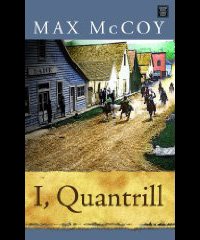
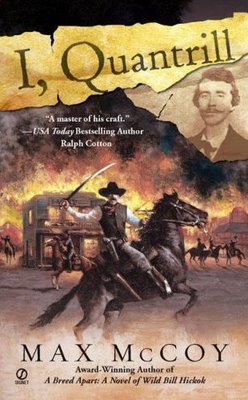
Had a telephone interview this morning with Paul Simpson, who is writing a piece on my Indy novels for the official Indiana Jones magazine. He's a nice chap (he and the magazine reside in England) and he did me the courtesy not only of reading the Indy books, but also my most recent novel, I, QUANTRILL.

Refreshing.

But, you'd expect this kind of preparation from somebody who wrote The Bond Files: The Unofficial Guide to World's Greatest Secret Agent. Paul asked informed -- and sometimes difficult -- questions. Like, my reaction when I learned that the title for Indy IV was "Kingdom of the Crystal Skull." I don't think he'll be able to print my answer, at least not verbatim.

He also asked me what it was like to create the backstories for Belloq and Sallah (that was fun), and which of the novels was my personal favorite (HOLLOW EARTH). He also asked if I meant what I said about passing the hat and whip in the afterword to the last novel.

Yep, I meant it.

Christ, I'm a Republican

The vote's in, and the $700 billion bailout has been defeated in the House, 228-205.

Republicans voted 2-1 against the bill (although both the GOP and Democrat leadership backed the administration's plan). The Kansas Congressional delegation voted against it by a margin of 3-1. Republicans Jerry Moran and Todd Tiahrt both voted no, along with Dem Nancy Boyda. Dennis Moore, an Overland Park Democrat, was the only Kansan to vote in favor of the bailout.

There must be something seriously wrong with the universe if my thinking not only matches that of most GOP members, but also of the Kansas delegation. The world as we once knew it has truly ended. And faced with a vote of no confidence, Wall Street lost $1.2 trillion in the biggest point drop ever. In terms of percentages, however, the drop didn't even make the top 10, so it's not curtains yet.

Don't be fooled again

House Speaker Nancy Pelosi has been drinking the administration's Kool-Aid.

"We sent a message to Wall Street -- the party is over," Pelosi said after an "improved" $700 billion bipartisan bailout agreement was hammered out between House and Senate leaders on Sunday, CNN reported.

Well, no. The message being sent to Wall Street is that no matter how badly you fuck up, the government will always be there for you. All you have to do is to fail big -- the bigger the better, in fact. And have powerful friends.

But if you're a working stiff, forget it. The full force of the government will come down on you like a ton of bricks if you can't pay your taxes, or default on your mortgage, or fall behind on your credit cards because you get sick. The government passed a battery of laws in the last 10 years that made it tougher for those behind the eight ball. They tightened the bankruptcy laws and gave lenders, especially credit card companies, unprecedented power to unilaterally change the terms of your loan.

And don't kid yourself, the splurge won't work.

At no time since the Great Depression has there been such an unequal distribution of wealth. The top 1 percent take 80 percent of the wealth. And while those on the bottom have increased productivity by 20 percent, wages have remained stagnant or lost ground to inflation.

No wonder the average American is outraged and calls to Congress against the bailout have been running 200-1. How, in hell, could Congress then hammer out a deal to pass it in the face of such opposition? Because, once again, the administration has used fear to manipulate the political process. But the bailout won't work. It's a stunt, really, designed to instill confidence and to shield the rich from their own folly.

Allan Sloan, senior editor at large at Fortune Magazine, has this to say:

"The proposed bailout of the world's financial system isn't really about money, folks. It's about psychology. In fact, you can think of it as the most expensive piece of psychotherapy in the history of the world."

Friday, September 26, 2008

Larwrence reprise

Those quirky free staters will get another shot at me this weekend, when I appear at the second annual River City Reading Festival. At about 10 in the morning, I'll be reading an excerpt from I, QUANTRILL, just in case there are any Lawrence residents who aren't pissed off yet.

The novel, which is a first-person narrative of the final weeks of the notorious guerrilla chieftain William Clarke Quantrill, inflamed the editorial board of the Lawrence Journal-World. Why, they asked a bit snarkily, should they care if Quantrill had a difficult relationship with his mother?

Well, it probably contributed to Quantrill's decision to burn Lawrence to the ground in 1863... But, you have to give the Lawrence paper credit. They are quick to step up and bravely challenge a foe that's been dead for 143 years.

Seriously, I've heard from many Lawrentians who say they get that the book is a work of fiction. They say that anybody who reads the novel realizes that while Quantrill is portrayed as a human being, he isn't a hero.

To form your own opinion, please read the damned book.

Thursday, September 25, 2008

Sounds good to me

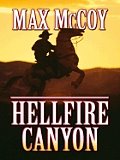
My Spur Award- and Kansas Notable Book-award winning novel, HELLFIRE CANYON, will soon be released as an audio book. At least that's the word from my publisher, Kensington.

It's already available as a large-print edition (shown at left). Hate the cover.

Wednesday, September 24, 2008

Not only no, but hell no!

In his address to the nation tonight, President Bush said that immediate action was needed, in the form of a $700 billion bailout of mortgage-based securities. "We're in the midst of a serious financial crisis, and the federal government is responding with decisive actions," CNN reported Bush as saying.

But Bush urging quick action on anything is enough to make me think doing nothing is the best course.

More and more, this emergency bailout seems geared to protecting Bush's monied friends rather than saving the economy. It is as if the administration decided to loot the treasury in the weeks they have left, stuffing their pockets with everything they can get. It's the same as waging a largely privatized war so that your friends, the Blackwaters and Halliburtons of the world, can get rich.

This economic crisis was nearly 30 years in building. The people who created it all got rich and will stay rich, what with their multi-billion dollar bonuses and golden parachute deals. I'm thinking, what is worse? Plunging taxpayers another $700 billion in debt? And you know the way the government estimates costs, it could really be a trillion dollars or more. A trillion dollars. This will devalue an already beleaguered dollar, once the international standard for economic stability. And when the dollar slips, rampant inflation will begin. When that happens, Wall Street will take Main Street down with it.

So, let's do nothing and see where we're at when the dust settles. Let the bums take it on the chin. Then, come January, let the new president sort it out. And as much as I admire John McCain for what he endured as a prisoner of war in Vietnam, I hope that he's not the people's choice. In an interview with 60 Minutes on Sunday, when asked about the economy, he actually invoked the name of Adam Smith. He didn't mention the unseen hand, but it was implied, almost like code to say, 'Look, I really do have the interests of the rich at heart, you know because I speak your language. Behaving in one's own best interests only makes sense.'"

I wish 60 Minutes would ask Lewis Lapham what he thinks about all this.

Peronslly, I think the current administration has cried wolf too many times for any rational person to take them seriously.

Sunday, September 21, 2008

The D word

Congress is about to buy up $700 billion worth of risky loans in a desperate attempt to avert financial disaster, but it may be too late. Things are bad and are quickly getting worse. This paragraph from today's developing story in the Wall Street Journal is particularly shocking:

Last week, as deep new fissures opened in global financial markets, the U.S. Treasury unveiled a plan to spend up to $700 billion to buy soured mortgages and mortgage-related securities from financial institutions. In many respects, the financial sector last week all but ceased to function.

Consider that last phrase: the financial sector had "all but ceased to function."

Another item, again from the WSJ:

The Federal Reserve agreed to convert Morgan Stanley and Goldman Sachs into traditional bank holding companies. With the move, Wall Street as it has long been known will cease to exist.

No more investment banks. Morgan Stanley and Goldman Sachs will be holding companies, buying up troubled banks and shielding them from the type of nervous investors who toppled Lehman Brothers, Bear Stearns, and Merrill Lynch.

The financial sector has ceased to function. Wall Street, in any known form, will cease to exist.

And consider how much $700 billion really is. That's $2,295 in additional debt for every man, woman, and child in the United States. And this is to rescue the financial institutions, not to help the taxpayers who are responsible for paying the bill. This is the socialization of debt on a grand scale. If you are Fanny Mae or Freddy Mac, or AIG or Lehman, your losses are covered by the taxpayers. We have, in effect, nationalized the mortgage industry.

Now, of course, if you are a taxpayer in trouble, don't expect a dime's worth of help from the government. If I fail to make my mortgage payments, the bank will take my house. Nobody in Washington is concerned if my retirement fund loses money (and, in fact, it has). And I'm lucky. What about people who are homeless? What about people without retirement accounts? And what, for God's sake, about the number of people (and many of them working hard for a living) who have no health insurance?

Another WSJ story leads with:

With as few as 72 hours before Congress votes on a federal financial-markets rescue, the financial industry has launched a ferocious effort to shape key provisions, in a fight that could yet stall the bill. Lobbyists and financial-services executives are working deep connections within the administration to ensure as many institutions as possible benefit from a $700 billion federal mechanism to buy distressed assets, then sell them off in better times. In a particularly controversial move, they also oppose proposals by Democrats in Congress to provide mortgage reductions for homeowners facing bankruptcy.

This is outrageous.

The presidential candidates and sitting politicians will rush this week to create a "Newer Deal" promised to stave off financial disaster. Only, they won't be able to do it. This financial collapse is global, and to try to stop it will be like trying to stop a tsunami. And the politicians of both parties have taken lobby money for so long from the very people that have created this nightmare that their knee-jerk reaction will be to protect those familiar monied interests instead of who they really are supposed to work for, the people.

How about socializing health care instead of corporate profits? How about investing in jobs programs instead of passing laws which give the credit card companies more profit and less regulation? How about making sure that all the children in this country have enough to eat instead of letting the CEOs of these negligent corporations bail out with their golden parachutes intact?

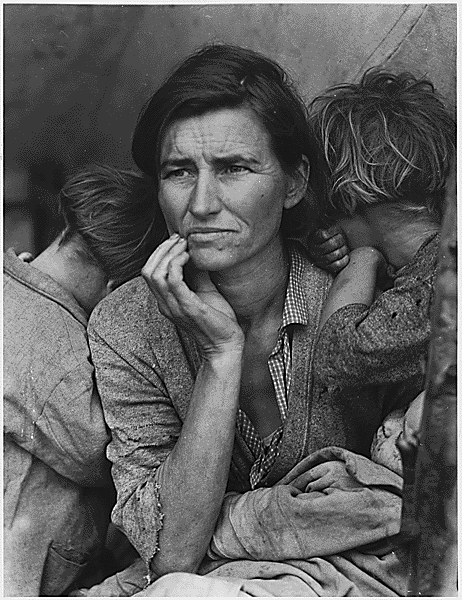
We're not supposed to mention the D word -- Depression -- for fear of creating a panic. After all, things can't be that bad. But take a look at the photo above. It is, of course, Migrant Mother, the famous 1936 photo taken by FSA photographer Dorothea Lange. This is what's at stake. Don't panic, but don't go shopping, either.

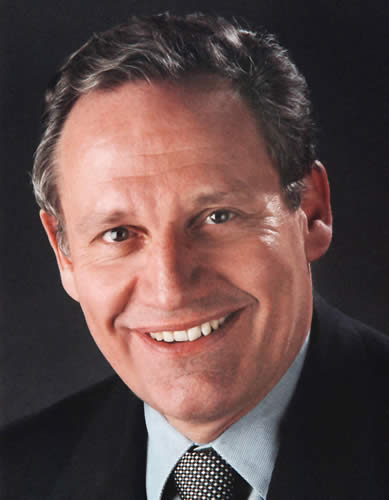
What the hell is Bob Woodward talking about?

On Sixty Minutes last week, Bob Woodward (you remember, the guy who with buddy Carl Bernstein broke the Watergate story and inspired a generation of journalists) said the US military had a secret weapon that was akin to the tank or the airplane in the evolution of warfare.

In an interview with Scott Pelley, Woodward said he knew the secret but couldn't reveal it. The surge in Iraq had worked, Woodward said, not because of the increase in troops but because of a new technology that allows the military to locate and kill individual insurgents. He compared this "sophisticated and lethal special operations program" to the Manhattan Project, which developed the atomic bomb.

Terrific. What kind of fresh Orwellian hell is this? We know how much safer the atomic bomb the world. And of course we'll only use this wonderful new weapon against the bad guys, right? And nobody else will ever get it, right?

It is unsettling that a journalistic icon would withhold information. He said he was doing it out of a desire to protect lives, that to reveal the information would "get people killed." Okay, maybe. But if so, then probably best not to mention it at all. Unfortunately, it sounds more like he's been drinking the DOD's Kool Aid. I cannot imagine any program, short of the old (and discredited) Star Gate psychic intelligence, which would so dramatically change the face of warfare.

Friday, September 19, 2008

Take it easy

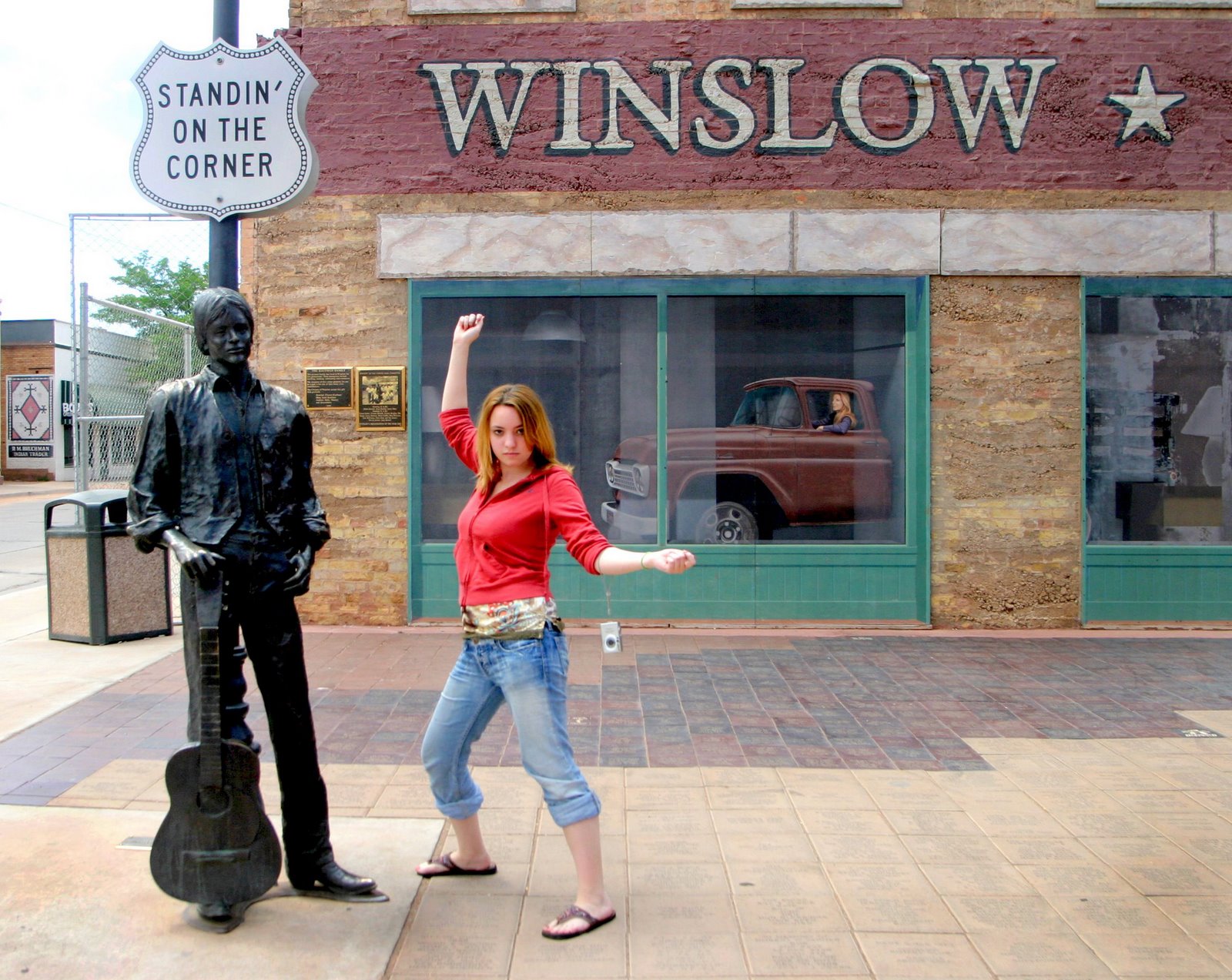
Long time no blog. Meanwhile, here's another image from the summer road trip. That's my youngest daughter standing on the corner in Winslow, Arizona. The chords of "Hotel California" were wafting from a loudspeaker across the street. Have always wanted to see this corner, and I'm glad I did, but can't say it was a religious experience. Seemed a bit tacky. Can't say the Eagles would approve. After gawking a bit, we were back on the road in the Jeep to Santa Rosa, New Mexico, where I strapped on scuba gear and dove the Blue Hole.

Wednesday, September 3, 2008

Okay, maybe a little sympathy...

My friend, Red Shuttleworth, is in the wonderful habit of sending me real letters on real paper. The other day he sent me a few lines about I, QUANTRILL.

"You gain sympathy for Quantrill," he says. "Back in playwriting school, there was an exercise called Villian's Worst Deed: the point was to wrtie a sympathetic monologue for someone beyond redemption. Few writers can pull this off. You carried Quantrill into the landscape of the tragic, for he was morally equal to his adversaries... your Quantrill has an equal legitimacy to exist. That took splendid writing."

He also says some nice things about some minor characters, including Blue Fugate and Mary Culhain.

"Great work," Red says. "No straw men or straw ideas. Just straight-ahead great, daring writing."

Praise indeed from Red, who is no slouch when it comes to writing.

His praise includes: Best Living Western Poet -- True West, 2007. 1st Spur Award for Poetry -- Western Writers of America, 2001. "Like Cormac McCarthy..." -- Kirk Robertson, 2000. "Shuttleworth emerges as the true Western hero." --Las Vegas City Life, 2000. "Red Shuttleworth is a phenomenon among literary figures of the American West." -- J.V. Brummels, 1997. Red Shuttleworth is the author of the Spur Award-winning Western Settings and numerous poetry chapbooks, including Backtrack, Brief Lives, and Doc Holliday's Skeleton Takes a St. Patrick's Day Walk, Leadville, Colorado, 1887. Red's plays have been presented at the Utah Shakespearean Festival, Sundance Playwrights Lab, the Sun Valley Festival of New Western Drama, the Churchill Arts Council (Nevada), and at many other professional and academic theatres. Red's poems have appeared in over 200 journals, including South Dakota Review, New Letters, Ontario Review, Blue Mesa Review, True West, Concho River Review, Prairie Schooner, Rattle, Flyway, Elysian Fields Quarterly, Aethlon, Hubbub, and Suisun Valley Review.

By the way, Lawrence residents will have a chance to take another shot at me at the River City Reading Festival on Sept. 27.

Sympathy for the devil?

The Lawrence Journal-World has denounced my novel, I, QUANTRILL. The subhead was, Why should we care whether William Quantrill had an unpleasant relationship with his mother?

"It is difficult to believe we need a book purporting to show the 'human side' of William Quantrill, who led the devastating 1863 raid on Lawrence," the Journal-World said in an editorial. "Who really cares, except perhaps devotees of the Confederacy, who still are inclined to consider this murderer a hero."

I'm flattered, of course. Despite the claims that nobody cares, the Journal-World did devote a rather lengthy article and an editorial full of righteous bluster to my novel. But my goal was not to create sympathy for the devil.

But if the Journal-World editorial board had actually read my damned book, they would have known that already. The novel is not an apologetic. It is intended as a bloody and gritty and sometimes surreal first-person account of the last weeks of the infamous guerrilla's life. It is, if anything, an indictment of the cycle of violence of which the raid on Lawrence was a part. And it doesn't let Quantrill off the hook -- in the end, paralyzed and waiting for death, he recognizes his culpability, and is damned by it.

"The 244-page book notes that Quantrill died in 1865 in Kentucky after being shot by Union supporters," the editorial continues. "Most of us familiar with the depth and scope of the atrocities committed in that 1863 slaughter are inclined to hope he suffered."

After 145 years, so apparently is Lawrence.

Wednesday, August 13, 2008

No blood spilled in Lawrence

Not a shot was fired when I addressed a near-capacity crowd in the auditorium of the Lawrence Public Library last night.

Of course, I really wasn't worried, despite the spirited online discussion on the Lawrence Journal-World website following their story about my attempts to "humanize" William Clarke Quantrill, who burned Lawrence 145 years ago this month. A few posters, apparently angry that I had attempted to portray Quantrill as a human being in my novel rather than a monster, had threatened (anonymously, of course) to teach me a lesson during my visit to Lawrence.

Alas, none showed up. I was all prepared to give my "American Bosnia" lecture about the Civil War on the Border.

Instead, I got an enthusiastic and particularly well-behaved crowd who listened to me talk about my work for over an hour, then asked terrific questions. That was followed by a book signing hosted by The Raven Book Store, a Lawrence institution and a particularly good place to find a mystery novel or works of regional interest. It was a pleasure to meet Lisa and Heidi, the new owners of the shop, and I hope someday in the not-too-distant future I can bring my characters Richard Dahlgren (THE MOON POOL) or Andy Kelsey (HINTERLAND) back in new adventures so I can have signings there.

I have always believed that public libraries are a vital part of the cultural and intellectual life of any community, and I was grateful for such a good turnout in Lawrence. Thanks are particularly due to library liason Maria, who organized the event and made sure the word got out. Terry Rombeck's story in the Journal-World lead the arts section, and was teased above the flag on 1A. The appearance was part of Civil War on the Western Frontier, which goes through Aug. 21, the anniversary of the raid.

I'll be be back in Lawrence on Saturday, Sept. 21, for the River City Reading Festival. A partial list of other authors slated to appear are Thomas Frank, Michael L. Johnson, Candice Millard, Scott Heim, Scott Phillips, Steven Hind, Jim Hoy, Kevin Rabas, and Denise Low.

Tuesday, August 12, 2008

Another raid on Lawrence

At 7 p.m., if I'm not assassinated, I'm going to speak and sign books at the Lawrence (Kansas) Public Library. The Lawrence Journal-World ran a story today on my appearance, under the head Devil's Advocate: Emporia author seeks to humanize Quantrill. This story has generated dozens of comments on the Journal-World's site, and a surprising amount of passion, regarding my novel, I, QUANTRILL.

Take this post, for example:

This publicity-seeker's 15 minutes of fame isn't going to change (W.E. Connelly's 1910 portrayal of Quantrill). I'll tell you one thing: If this guy had been born a lot earlier and had shown up in Lawrence to promote a book like this even as late as the 1940's, he'd have been tarred and feathered and run out of town on a rail.

Okay. Perhaps I should repeat that my book is a novel, not history, and it is told from the point-of-view of the fevered dream of a dying man. Yes, I did a lot of research for it, but I wasn't trying to defend W.C.Q. It's a novel. And Quantrill wasn't all bad.

The post continues:

I happen to be out of town right now, but were I in Lawrence I would without a doubt show up at this guy's love-fest and make him wish that he'd stayed in Emporia for the day. As it is, when I return I will put it on my list to reread the copy of Connelly that has been in my family since it was published, so as never to forget the real William Clarke Quantrill and what happened in my forebears' beloved city on August 21, 1863.

Love-fest? Really.

There are some posters who are pointing out that Quantrill was not much better than Jim Lane, who raided Missouri and hid in a cornfield during the Lawrence Raid. There were a lot of atrocities to go around. It was war. And the cycle of violence continued for generations. But the point is that I, QUANTRILL is a novel, which means it is a fiction. I am drawn to writing about individuals that society has labeled as monsters. Such as Civil War serial killer Alf Bolin in HELLFIRE CANYON, which won the Spur award from the Western Writers of America.

Oh, well. I hope some of these posters actually show up at the library. Perhaps some of them will actually read the damned book. And by the end they'll find out that what my Quantrill did, even in his own mind, was unpardonable.

For an impartial newspaper review from someone who has actually read the book, click here.

Monday, August 11, 2008

Here's your shirt

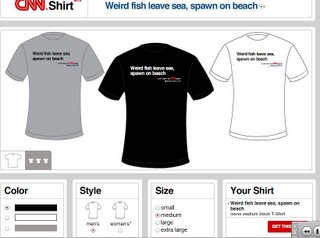
There's a tiny icon of a tee-shirt next to some stories at the CNN website. They started popping up earlier this spring and I had no damned idea what they were until I finally clicked on one of them and discovered you could order a tee-shirt (for only $15, plus shipping) featuring the story's headline with a tagline that says, I just saw it on CNN. Now, not just any headline can be made into a shirt.

There is apparently some litmus test the CNN applies to determine if the shirt-worthiness of a headline. "Nude man, cops tussle in gas station" was a lock this week. So was, "Farmer erects 'Redneck Stonehenge'" and "Snake slithers into weatherguy's pants." But the only headline offered today on a shirt was, "Vet shortage could cripple food supply." Okay, guess somebody at CNN has seen Soylent Green or the classic Twilight Zone episode, "To Serve Man."

But here are today's headlines that, inexplicably, aren't offered as shirts:

Bush hugs bikini-clad Olympians.

Bush wants to alter Endangered Species Act.

and

Russian military pushes into Georgia.