The FCC has slapped CBS with millions of dollars in fines for broadcasting "indecent" content. First, there was the Janet Jackson wardrobe malfunction at the 2004 Superbowl which cost the network $550,000. Last year, the commission handed down more than $3 million in fines for a teen orgy depicted in an episode of"Without a Trace." Just this week, the FCC announced its intent to fine CBS another $1.43 million for a bit of skin shown on a 2003 episode of "NYPD Blue."
None of these scenes were particularly graphic. Janet Jackson's exposed (and pierced) breast was allegedly shown by accident, the teen orgy was mostly blurred images of swaying bodies, and the semi-nude scene in "Blue" depicted a small boy getting a bathroom glimpse of a grown woman. Indecent? This wasn't pornography. And it wasn't indecent unless you consider breasts indecent, or story lines that deal with real-life issues. Yes, teenagers sometimes have orgies. The fictional orgy in question, by the way, resulted in consequences. And the bathoom scene in "Blue" was similarly well done.
But even if these fictional scenes hadn't been skillfully executed, the FCC has overstepped its bounds. It is now acting as a story and content editor for CBS, and it has a big stick. Of course, the FCC is bowing under pressure from "decency" groups that would like to ban breasts -- and apparently all depictions of youthful sexuality -- from the air.
It's unfortunate that the FCC has chosen this issue to put its considerable resources behind. The commission is responsible for protecting the public from far more than the occasional breast, and what I find truly indecent is the amount of advertising aimed at children. That type of advertising is banned, with good reason, in most of the world. Apparently, the FCC is dedicated to helping advertisers produce a generation of consumers while giving lip service to the idea of decency.
But judge for yourself. The offending scenes are offered below.
Wednesday, January 30, 2008
Monday, January 28, 2008
A thousand lies
 The Bush Administration lied 935 times in a "carefully orchestrated campaign of misinformation" in the runup to the invasion of Iraq, a new investigation by the Center for Public Integrity has concluded.
I'll save the rant.
But while we're on the topic, 60 Minutes had an interview with the guy who debriefed the captive Saddam Hussein before he was turned over to the Iraqis (and executed). Saddam said there were no WMDs, of course. But what I found troubling is that the FBI agent lied to Saddam on a daily basis for months to get the information. Not only did he pretend to be his friend, but he presented himself not as an FBI agent but as someone who was reporting directly to the president, and held charades to reinforce this impression. The FBI has touted the debriefing as among the top achievements in the agency's 100-year history. Sorry, but isn't it immoral to lie to a man you know will be put to death? But what I found particularly repugnant was that the FBI agent feigned admiration for Saddam's poetry in order to win his confidence. To lie is low, but to lie about literature is a sin.
A long time ago in a land far away, there was a long-held standard that the FBI did not operate overseas and that CIA did not operate domestically. The principle was to keep the FBI from meddling in foreign affairs and the CIA from spying on our own people. Well, we've crossed that Rubicon.


Wednesday, January 9, 2008
The author is always the last to know...
 To coincide with the release of INDY IV, Random House is reissuing all four of my Indiana Jones adventures. IJ AND THE PHILOSPHER'S STONE and IJ AND THE DINOSAUR EGGS will be available April 19 (a date that readers of my thrillers will recognize). IJ AND THE HOLLOW EARTH and IJ AND THE SECRET OF THE SPHINX will follow. I didn't have a clue until a colleague came to my office and said she was trying to get copies of the IJ novels for her students but was having trouble... I looked at her blankly, said they are typically available, and then went to the Internet. Found a fansite that said RH was republishing them. Then went to the Random House website and found their catalog and confirmed it. Really, would it have killed somebody in NY to have called and told me? By the way, if you want to read about Indy's first encounter with the Crystal Skull, read PHILOSOPHER'S STONE. The Skull is a continuing story through all four books, ending with SPHINX, the last original Indy novel. The only change in the books is the price, I believe. They are now $7.50.
Tuesday, January 8, 2008
Paging Doctor Bombast
"It's true people sometimes need to be placed under involuntary mental health treatment because they can't take care of themselves," veteran psychiatrist Dr. Jeffrey Sugar said of the 26-year-old Spears. "But there's a difference between being detained involuntarily for psychological treatment and being forced to endure Dr. Phil involuntarily." -- from an AP story about Dr. Phil McGraw's uninvited visit to Brittany's hospital room.
Thursday, January 3, 2008
New law won't change fed secrecy policy
You may have read (here and elsewhere) about the OPEN Government Act, a new law which makes several important changes to the Freedom of Information Act. It is meant to encourage better response times, allow requests to be tracked, and expand the basis for fee waivers. But what it doesn't do, according to the FAS Project on Government Secrecy, is to restore the "presumption of openness" that was demolished by John Ashcroft.
That provision was removed from the bill's final form.
From Steven Aftergood's Secrecy News:
Whatever records that a government agency was legally entitled to withhold before enactment of the "OPEN Government Act" can still be withheld now that the President has signed it.
Some reporters and editorial writers, perhaps enchanted by the name of the new law, mistakenly assumed that it accomplishes much more than that. "The law ... restores a presumption of a standard that orders government agencies to release information on request unless there is a finding that disclosure could do harm," according to a January 1 Associated Press account that appeared in the Washington Post, the New York Times, USA Today, the Wall Street Journal and elsewhere.
Further, the widely-published AP account continued, "The legislation is aimed at reversing an order by former Attorney General John Ashcroft after the 9/11 attacks in which he instructed agencies to lean against releasing information when there was uncertainty about how doing so would affect national security."
But that is incorrect.
Although the original House version of the OPEN Government Act did include a provision that would have repealed the Ashcroft policy and established a "presumption of openness," that provision was removed from the bill prior to passage.
Thus, Rep. Henry Waxman (D-CA) noted with regret on the House floor on December 18 that the final legislation "does not include a provision which I thought was a key one establishing a presumption that government records should be released to the public unless there is a good reason to keep them secret."
That provision was removed from the bill's final form.
From Steven Aftergood's Secrecy News:
Whatever records that a government agency was legally entitled to withhold before enactment of the "OPEN Government Act" can still be withheld now that the President has signed it.
Some reporters and editorial writers, perhaps enchanted by the name of the new law, mistakenly assumed that it accomplishes much more than that. "The law ... restores a presumption of a standard that orders government agencies to release information on request unless there is a finding that disclosure could do harm," according to a January 1 Associated Press account that appeared in the Washington Post, the New York Times, USA Today, the Wall Street Journal and elsewhere.
Further, the widely-published AP account continued, "The legislation is aimed at reversing an order by former Attorney General John Ashcroft after the 9/11 attacks in which he instructed agencies to lean against releasing information when there was uncertainty about how doing so would affect national security."
But that is incorrect.
Although the original House version of the OPEN Government Act did include a provision that would have repealed the Ashcroft policy and established a "presumption of openness," that provision was removed from the bill prior to passage.
Thus, Rep. Henry Waxman (D-CA) noted with regret on the House floor on December 18 that the final legislation "does not include a provision which I thought was a key one establishing a presumption that government records should be released to the public unless there is a good reason to keep them secret."
Thursday, December 27, 2007
Ivers on Writing
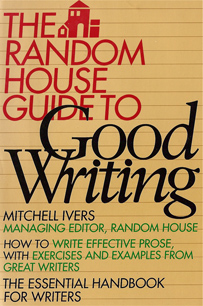 A fine book is Mitchell Ivers's The Random House Guide to Good Writing. Ivers was managing editor of RH when the book was published in 1991, but he's now senior editor at Pocket Books. His book is just one of a very few writing how-tos I've found helpful, and my copy was given to me years ago by my friend and fellow author Fred Bean -- now the late Fred Bean. And speaking of Fred, his funeral was so strange and poignant (outdoors, with doves and mysterious women weeping in back) that it must eventually become a scene in one of my novels. But back to this book by Ivers, which has been on my writing desk for the last few weeks, along with The Elements of Style and The American Heritage Dictionary. I'm in the midst of proofing galleys of I, Quantrill, to be released in May 2008 by New American Library, and I find the Ivers book an excellent reference. In the interest of disclosure, NAL is an imprint of Penguin, but I don't deal with Ivers because he is so far up the food chain. The Guide is still in print and can be had in a mass market edition for about seven bucks from Amazon.
Tuesday, December 25, 2007
A fine pair from Texas
Two winners from the Texas Monthly 2008 Bum Steer Awards, one about a former Pittsburg State University football coach and another about a television journalist who was nabbed for suspicious behavior in the maternity wards of a couple of Amarillo hospitals.
"Of all the Bum Steer sagas that played out over the past year, however, none was stranger than that of the man ESPN called “dumber than a blocking sled.” Yep, it’s the Aggies’ own Dennis Franchione. His $2 million salary evidently wasn’t enough; he moonlighted as the author of a VIP newsletter, which he sent out by e-mail to 23 well-heeled boosters willing to pay $1,200 for inside dope about injuries and recruits. Unsportsmanlike conduct! When A&M learned of his other gig, the university had to report two rules violations to the NCAA. Even beating Texas two years in a row couldn’t keep him in his job. Congrats, Coach Fran. You’re the Bum Steer of the Year."
Well, my (admittedly slight) connection to Franchione is that I got my undergraduate degree at PSU. I often say in my journalism class that sports really isn't news unless they execute the losers. But I'll make an exception for greed and corruption.
And this gem:
"Coming up at ten: She does five. Cecelia Lynn Coy-Jones, a reporter for KCBD-TV, in Lubbock, was arrested for attempted aggravated kidnapping after lurking in the maternity wards of two Amarillo hospitals, because, she claimed, she was investigating how secure they were from would-be kidnappers."
I'm all for enterprise reporting, but when you appear to be a threat to children, you're begging for trouble. My advice to Coy-Jones: While the occassional stolen baby story makes for breathless copy, it's the damned politicians and bearucrats that really need watching. Lurk in city hall instead.
"Of all the Bum Steer sagas that played out over the past year, however, none was stranger than that of the man ESPN called “dumber than a blocking sled.” Yep, it’s the Aggies’ own Dennis Franchione. His $2 million salary evidently wasn’t enough; he moonlighted as the author of a VIP newsletter, which he sent out by e-mail to 23 well-heeled boosters willing to pay $1,200 for inside dope about injuries and recruits. Unsportsmanlike conduct! When A&M learned of his other gig, the university had to report two rules violations to the NCAA. Even beating Texas two years in a row couldn’t keep him in his job. Congrats, Coach Fran. You’re the Bum Steer of the Year."
Well, my (admittedly slight) connection to Franchione is that I got my undergraduate degree at PSU. I often say in my journalism class that sports really isn't news unless they execute the losers. But I'll make an exception for greed and corruption.
And this gem:
"Coming up at ten: She does five. Cecelia Lynn Coy-Jones, a reporter for KCBD-TV, in Lubbock, was arrested for attempted aggravated kidnapping after lurking in the maternity wards of two Amarillo hospitals, because, she claimed, she was investigating how secure they were from would-be kidnappers."
I'm all for enterprise reporting, but when you appear to be a threat to children, you're begging for trouble. My advice to Coy-Jones: While the occassional stolen baby story makes for breathless copy, it's the damned politicians and bearucrats that really need watching. Lurk in city hall instead.
That's no moon... it's season's greetings.
 Each year, I get a holiday card from Lucasfilm (because of some Indiana Jones novels I did a few years back). Every card is a whimsical take on some part of the Lucas universe. This year had three rows of pop-up stormtroopers holding candles and songbooks. And, as usual, the card said a donation had been made in my name to charity. it also had a handwritten greeting from a top Lucasfilm employee (no, I don't mean George). Christmas is not my favorite time of year -- that would be Halloween -- but I do look forward to getting these seasonal tidings from my friend at the Presidio.
Wednesday, December 19, 2007
If Bush thinks it's bad... it must be good.
In my journalism classes, I stress the importance of open records and require all of my students to file at least one request per semester. Secrecy, however, has been the rule at the Bush White House, and a campaign has been waged to diminish FOIA -- the federal open records act -- and to encourage officials to ignore, delay, and deny requests. The issue is so important that I include here, in full, an upate on an attempt to strengthen FOIA.
From the National Security Archive:
House Poised to Pass FOIA Reform Bill
Bill Provides “Common Sense” Solutions for Openness Problems:
Penalties for Delays, Tracking Systems for Requests,
Ombuds-style Office to Mediate Disputes, Better Agency Reporting
Reforms Recommended by Archive Audits and Testimony
Washington, DC, December 18, 2007 – The House of Representatives will vote today on a Freedom of Information Act (FOIA) reform bill (S. 2488) that passed the Senate by unanimous consent on December 14. The bill aims to fix some of the most persistent problems in the FOIA system, including excessive delay, lack of responsiveness, and litigation gamesmanship by federal agencies. If passed by the House today, it will be sent to the President’s desk for approval.
“Our six government-wide audits of FOIA performance show that these bipartisan changes to the Freedom of Information Act are common sense solutions,” remarked Meredith Fuchs, general counsel of the National Security Archive. “This bill establishes tracking systems for FOIA requests like FedEx uses for packages, actually penalizes agencies for the first time for delays that our audits found could reach 20 years, and sets up an office to mediate disputes as an alternative to litigation.”
The bill in front of the House today represents a bipartisan effort that has stretched over several years, spearheaded by Senators Patrick Leahy (D-VT) and John Cornyn (R-TX), the original co-sponsors of the OPEN Government Act of 2007, Senator Jon Kyl (R-AZ), and Congressman Henry Waxman (D-CA). Efforts to amend the FOIA have faced stumbling blocks in part because of strong administration opposition to passage of earlier versions of this FOIA reform bill in both the House and the Senate.
“This is the bill that President Bush wrote an executive order to try to prevent,” said Tom Blanton, director of the Archive, referring to E.O. 13392 (December 14, 2005), which called for a “citizen-centered and results-oriented approach” to FOIA, established Chief FOIA Officers at each of 92 major agencies, and required agencies to evaluate their FOIA programs and draft improvement plans.
The new law would mandate tracking numbers for FOIA requests that take longer than 10 days to process to ensure they will no longer fall through the cracks, require agencies to report more accurately to Congress and the public on their FOIA programs, create a new ombuds office at the National Archives to mediate conflicts between agencies and requesters, clarify the purpose of FOIA to encourage dissemination of government information, and provide incentives to agencies to avoid litigation and processing delays.
“Congress is acting to improve the FOIA for the first time in more than a decade, since the electronic FOIA amendments of 1996, but Congressional and public oversight will be essential for the law’s success,” Blanton noted. “Our Knight Open Government Survey in 2007 found that only one in five federal agencies fully complied with the 1996 law, even after 10 years of implementation.”
From the National Security Archive:
House Poised to Pass FOIA Reform Bill
Bill Provides “Common Sense” Solutions for Openness Problems:
Penalties for Delays, Tracking Systems for Requests,
Ombuds-style Office to Mediate Disputes, Better Agency Reporting
Reforms Recommended by Archive Audits and Testimony
Washington, DC, December 18, 2007 – The House of Representatives will vote today on a Freedom of Information Act (FOIA) reform bill (S. 2488) that passed the Senate by unanimous consent on December 14. The bill aims to fix some of the most persistent problems in the FOIA system, including excessive delay, lack of responsiveness, and litigation gamesmanship by federal agencies. If passed by the House today, it will be sent to the President’s desk for approval.
“Our six government-wide audits of FOIA performance show that these bipartisan changes to the Freedom of Information Act are common sense solutions,” remarked Meredith Fuchs, general counsel of the National Security Archive. “This bill establishes tracking systems for FOIA requests like FedEx uses for packages, actually penalizes agencies for the first time for delays that our audits found could reach 20 years, and sets up an office to mediate disputes as an alternative to litigation.”
The bill in front of the House today represents a bipartisan effort that has stretched over several years, spearheaded by Senators Patrick Leahy (D-VT) and John Cornyn (R-TX), the original co-sponsors of the OPEN Government Act of 2007, Senator Jon Kyl (R-AZ), and Congressman Henry Waxman (D-CA). Efforts to amend the FOIA have faced stumbling blocks in part because of strong administration opposition to passage of earlier versions of this FOIA reform bill in both the House and the Senate.
“This is the bill that President Bush wrote an executive order to try to prevent,” said Tom Blanton, director of the Archive, referring to E.O. 13392 (December 14, 2005), which called for a “citizen-centered and results-oriented approach” to FOIA, established Chief FOIA Officers at each of 92 major agencies, and required agencies to evaluate their FOIA programs and draft improvement plans.
The new law would mandate tracking numbers for FOIA requests that take longer than 10 days to process to ensure they will no longer fall through the cracks, require agencies to report more accurately to Congress and the public on their FOIA programs, create a new ombuds office at the National Archives to mediate conflicts between agencies and requesters, clarify the purpose of FOIA to encourage dissemination of government information, and provide incentives to agencies to avoid litigation and processing delays.
“Congress is acting to improve the FOIA for the first time in more than a decade, since the electronic FOIA amendments of 1996, but Congressional and public oversight will be essential for the law’s success,” Blanton noted. “Our Knight Open Government Survey in 2007 found that only one in five federal agencies fully complied with the 1996 law, even after 10 years of implementation.”
Monday, November 12, 2007
Unnatural Bridge

 Not far from the castle (see post below) at Ha Ha Tonka Park is a natural bridge. It seemed more than a little spooky to me. I couldn't help but wonder how many crimes have been committed in the shadows below. The park is located near Camdenton, in the heart of Missouri's spectacular karst. There are lots of caves, cliffs, and sinkholes. The name of the park allegedly means "laughing water" in Osage, but I'm suspicious -- having studied more than a few Native American words, I'd guess that it means something closer to "sacred waters." Or not. The photo below is a tighter shot, showing the arch, which is quite large -- large enough, in fact, for several adults to stand beneath with plenty of headroom. You could even get horses in there. A great place to hide and a terrific setting for a story.
Ozark Olympus
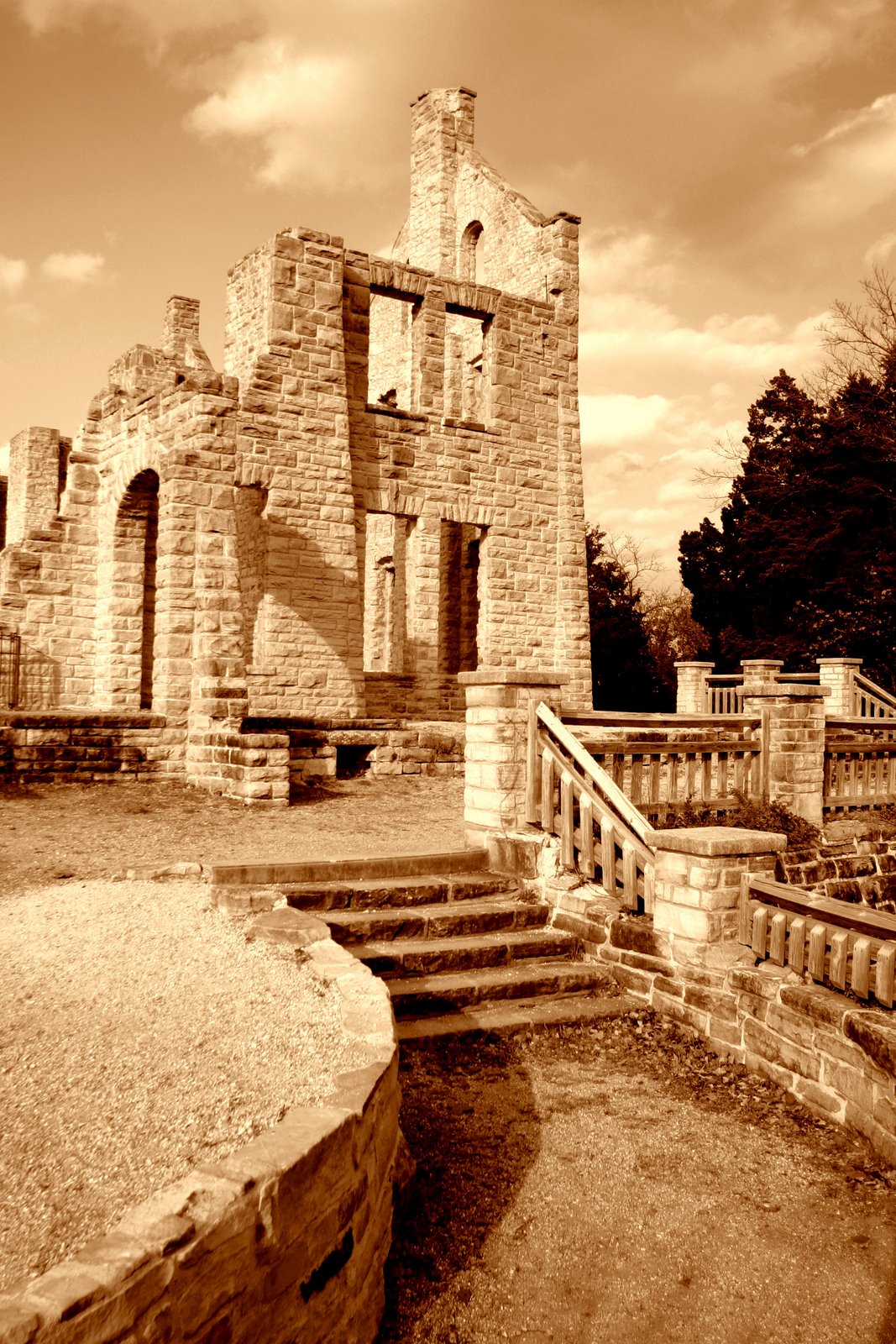 Okay, this is one of the weirdest things I've encountered in a spell. I went trout fishing at Bennett Spring (catch and release only this time of year) over the weekend and, since I was close, took a side trip to Ha Ha Tonka State Park. On the top of the highest mountain are the ruins of a castle built by a Kansas City businessman named Snyder in 1905. Snyder died in an automobile accident in 1906 (yes, one of the first car accidents in Missouri) and the castle operated as a hotel until it burned in 1942. What's left is surreal. The Roms (the Romantics) would have loved it. The ruins would be a terrific place for a Shakespeare festival. I can easily imagine Hamlet performed below.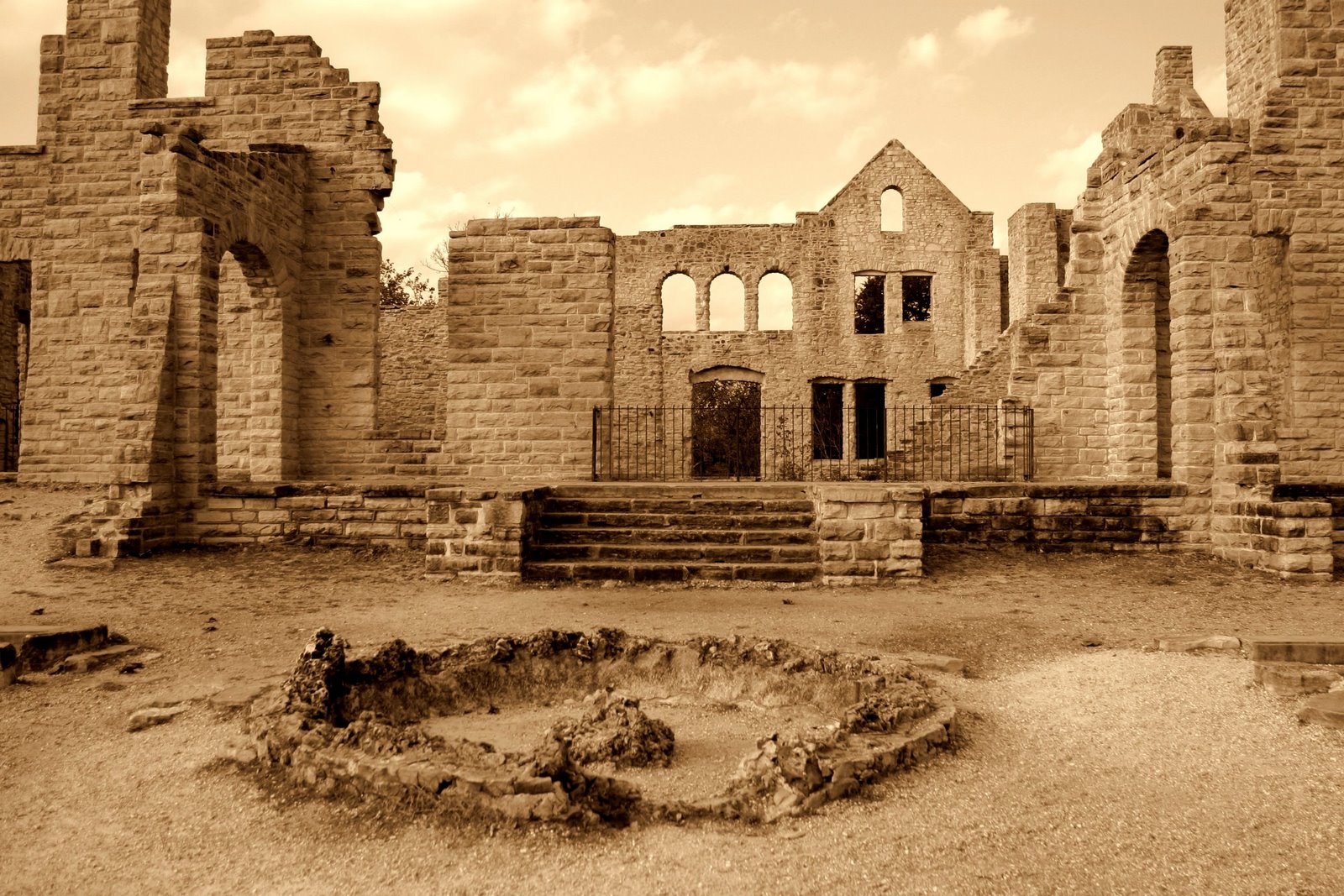
Wednesday, October 31, 2007
Times Square
 I was in New York during the last weekend of October for research on the meteorite book, to meet with my agent, and to talk with some publishers. Here's the obligatory photo of Times Square. Don't want to say too much about the visit because, well, it will be in the book. But I can say my editor at Kensington treated me to a great Italian dinner in the Village. Thanks, Gary -- you know who you are!
Sunday, September 30, 2007
The Beacon
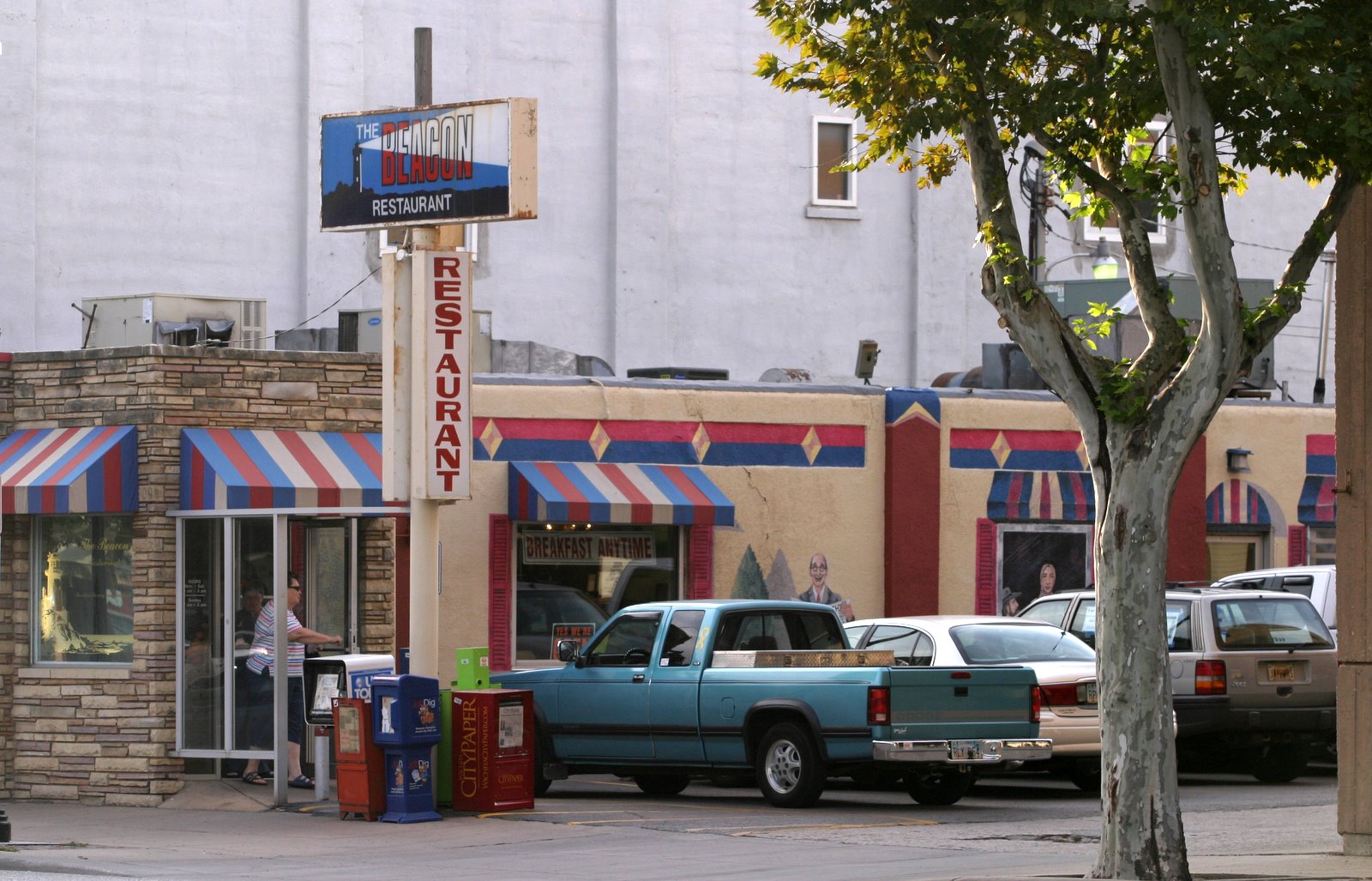 The Wichita Beacon newspaper has been gone since 1980, when a century of competition ended with a hyphenated merger. But the Beacon Restaurant continues at 909 E. Douglas, opposite the docks of The Wichita Eagle (which was the Eagle-Beacon to 1989). The Beacon is a fine newspaper restaurant, although it is no Billy Goat's Tavern. I was in Wichita for a journalism-type retreat Saturday and found time for a ham-and-cheese omelet, fruit, toast, and coffee at said restaurant. Honestly, it was the best breakfast I've ever had in Wichita -- a town I mostly remember (for food at least) by horrid conference fare at the airport Hilton. I'm not crazy about Wichita, but The Beacon and nearby Old Town almost made me change my mind. Oh, did I mention said horrid writers convention at the airport Hilton was dry? No beer, no wine, no nothin'. Was forced to take refuge with some editor types at the Steak and Ale.
Tuesday, September 18, 2007
Amazing Grace 2001
Back in 2001, I attended the Missouri Shape Note Convention. The following story and photos were first published in The Joplin Globe. My friend, Bill Caldwell, introduced me to the fascinating culture of Shape Note singing. The following story was picked up the by the AP, can still be found elsewhere on the Web, and it remains one of my favorite story-and-photos packages. Cassie Franklin, the singer in the photo below, was later featured on the soundtrack of the movie Cold Mountain.
 PINCKNEY, Mo.--A stone's throw north of the Missouri River, where Highway 94 crosses a one-lane bridge and wends its way across the rich bottom land toward Jefferson City, shines a white country church against the muted background of late winter.
Here, beneath the peaked roof of the 131-year-old St. John's United Church of Christ, time stood still for an eclectic group of singers who practice an archaic form of music known as Sacred Harp.
"It expresses your feelings about God, about how it feels deep down inside your heart,"explained 48-year-old Alice Moran, who was one of a handful of Joplin-area singers at the two-day convention.
Others, however, said religion isn't necessary.
Gary Gronau, a 57-year-old folk music fan and self-described '60's civil-rights activist from St. Louis, cited the music itself as the biggest draw.
"In this room there are a lot of people who are very strongly religious, and then there are people who are atheists--like me," he said.
 Unlike most forms of music, which are intended for an audience, Sacred Harp is meant to be experienced. Harpers sing primarily for the joy of singing, said Gronau, and he repeated a quote attributed to legendary Georgia singer Hugh McGraw: "I will travel across the country to sing Sacred Harp, but I wouldn't walk across the street to listen to it."

Hollow square
For the uninitiated, the sound can be unpleasant. The lyrics are difficult to understand, unless a printed version is handy, and the seating arrangement of the singers is unlike that of any other kind of performance; unless you're participating, you're looking at their backs.
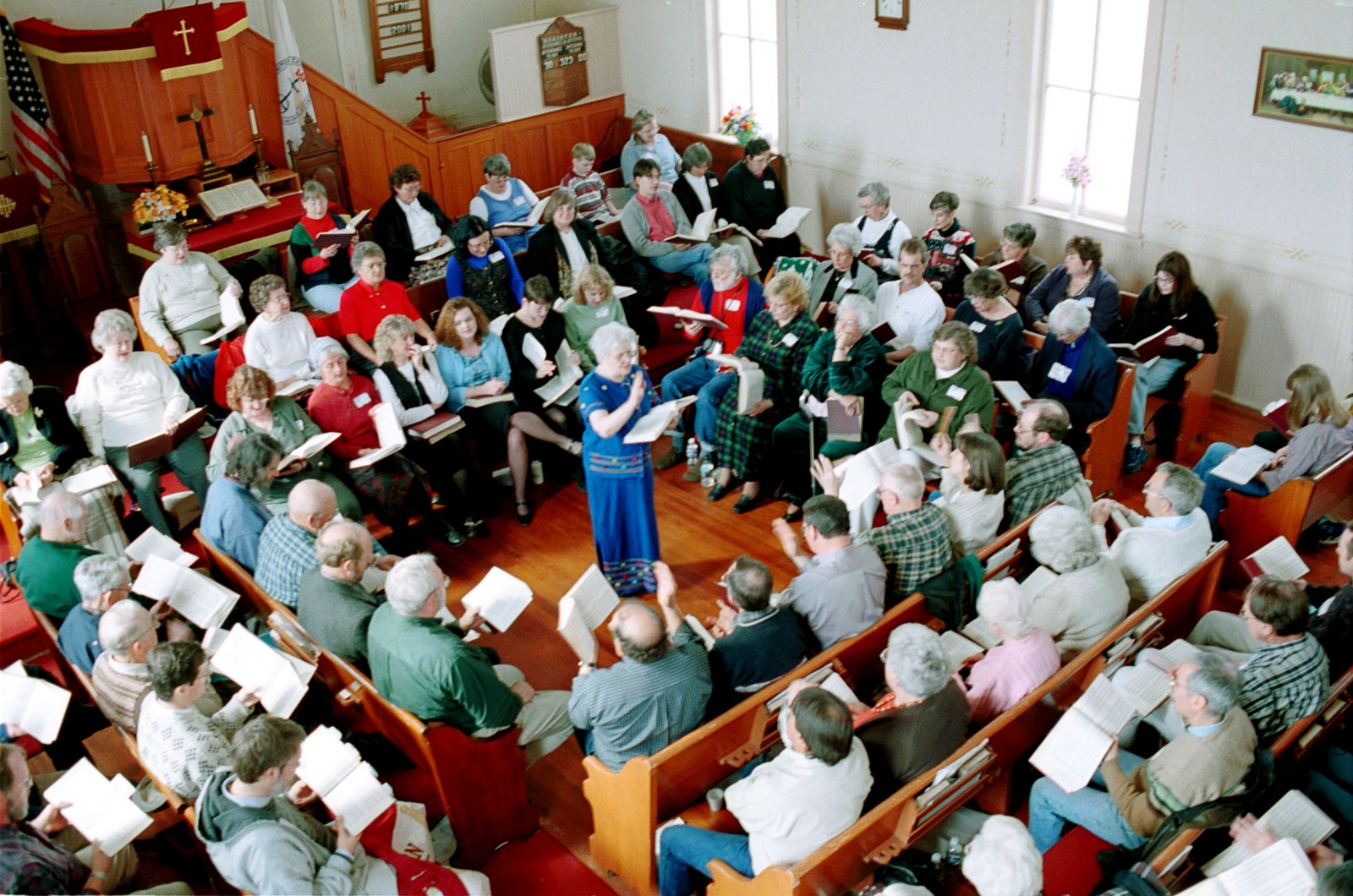
Members of the congregation sit in what is traditionally called a "hollow square," facing one another, and the music is divided into four parts, from bass to treble, with the melody carried by the tenors.
Song leaders stand in the center of the square and announce songs by calling out their page numbers from the most recent revision of the 1844 book, which stays open on the laps of most. Before they launch into a song, the leader has the group "sing the notes" of the melody while naming the shapes: "fa, sol, la." Pitches are adjusted to meet the needs of the group, so songs may or may not be sung in the keys in which they are written.
The leaders keep time with their hands, turn to coax the best performance from each section, and sometimes scold unruly children at the edge of the group with a well-aimed look. Meanwhile, the singers beat time with their feet, sing as if their lives depended upon it, and often are so swept away by the experience that their faces are portraits of joy.
Near the center of the group, the music not only leaves your ears ringing but can be felt thumping in your chest and abdomen. Veteran harpers tell a tale, perhaps apocryphal, that someone once measured the sound inside the hollow square and came up with a reading of just over 100 decibels--which approaches the level of an average rock concert, at least from a few rows back.
But volume is only one characteristic of Sacred Harp.
Instead of the usual triads found in religious music, the chords are filled with octaves, fourths and fifths. There is also the occasional discordant note, which somehow contributes to the power and also manages to send chills down your spine.
"It's way cathartic," Gronau said.
Primal appeal
Named for an 1844 book that collected the popular ballads and church hymns of the day, the Sacred Harp-style is sometimes called "shape note" because of its primitive system of notation.
 Although the tradtions began in New England, it quickly spread to the Midwest and antebellum South. Singing masters would travel from town to town, give lesson, and largely make their living by the sale of the oblong tune books such as "The Sacred Harp."
Their method taught musical sight reading by combining solmization, or syllable singing, with a notation system of four shapes that represent intervals instead of absolute pitches: triangle, oval, rectangle and diamond.
The advantage was that students unschooled in tradtitional musical notation could learn to sight-read quickly. Also, in the days long before television took the place of the family hearth or village well, the singing schools were an important social function.
"The singing master often appeared with a blackboard, charts showing tonal steps and their changes with keys, a pointer, pitchpipe, an armful of tune books, a love for music, and an earnest desire to teach people to sing," writes Shirley Bean, an associate professor of music at the University of Missouri-Kansas City, in the introduction to "The Missouri Harmony," a collection of 1820's frontier hymns reprinted recently by the University of Nebraska Press.
"The hopeful scholars brought firewood, slates or lapboards, candles, and an eagerness to learn the art of singing. The candles were sealed to the corners of the slates or boards to supply light. Seating was usually arranged in a semicircle severals rows deep. Instruction commenced with a presentation of the rudiments of music. . .soon the group was given exercises in voice placement."
Although most of the songs are religious in nature, some are ballads or commemorate events contemporary to the tune books. Some are unabashedly patriotic.
The spirits of Washington, Warren, Montgomery / lookdown from the clouds with bright aspect serene, begins a tune called "The American Star," which cites a trio of Revolutionary War heroes. Come, soldier, a tear and a toast to their memory / Rejoicing they'll see us as they once have been.
Other tunes can be described only as somber, even morbid.
Remember, you are hast'ning on / To death's dark, gloomy shade, the young are warned in "New Topia. " Your joys on earth will soon be gone / Your flesh in dust be laid.
"The words are imortant," observed Karen Isbell, a former president and founding member of the St. Louis singing group. "They're from a time when life was brutal. People had a different view of God and religion back then--primal, really stark and stripped down--and frankly, I think that's part of the appeal. Life mattered."
Rediscovery of style
While the music eventually died out in New England and the Midwest, it was passed uncorrupted from generation to generation in Primitive Baptist and other churches in the deep South. When a revival of interest in Sacred Harp music began around 1983 in places like Chicago and St. Louis, it was the Southern harpers who eventually showed the newcomers how to sing it full bore.
"We had been struggling along on our own," said Gronau, another founding member of the St. Louis Shape Note Singers.
At first, the members passed around barely legible photocopies from the original tune books, met in attics and basements, and tried their best to conjure the magic the printed matter only hinted at. Then, it occurred to Gronau to seek out those who had grown up in the tradtion, in much the same way blues fanatics had scoured the Mississippi delta seeking links to Robert Johnson and other masters. The result, Gronau said, was a rediscovery of a style that was "crisp and clean."
Also, Gronau learned, Sacred Harp is nothing short of a subculture based on a sort of musical communion, and bolstered by a tradition of shared meals and old-fashioned sensibilities. Harpers may travel across the state to attend a one-day "singing," or across the counry to attend one of the two-day state conventions like last weekend's 16 Annual Missouri Convention at Pinckney, for which the St. Louis group was host.
One of the new singers was Steven Henness, 28, a postgraduate student at the University of Missouri in Columbia. Henness, who holds a master's degree in rural sociology, had been traveling the state gathering information for a research project on community development when he heard of the upcoming convention. Although he attended because of his academic interest in rural tradtions, he soon found himself in the tenor section, singing from a copy of "The Sacred Harp."
"It was both exhausting and energizing at the same time," Henness said. "Instead of just trying to mechanically hit each note one after the other, I found myself being lost in the rhythm and power of the thing."
Also, Henness, the reason Sacred Harp is growing in popularity may be that it allows individuals "to ground their identities" in a tradition that is bigger and older than themselves. This, he said, is becoming increasingly difficult in a world that keeps changing faster than our forefathers could have imagined.
"I was not raised in this kind of tradition," said Elizabeth Senger, who drove with her family from LaCrosse, Wis., to attend the convention. "I was at a folk festival and I heard this stuff at a distance. I was curious, went to take a look, and somebody put a book in my hand."
For Senger, her faith is part of the experience.
"I find I worship better here than in my home church," she said. "There is a power to this kind of music that you don't find in popular culture. You feel connected to people that lived a hundred or more years ago. This morning, for example, we sang about the death of George Washington."
Another attraction, Senger said, is the democratic nature of the event: Song leaders are male and female, young and old, religious and not.
"You know, you hear people talk a lot about jazz as the only style of music that is native to America," she said. "Well there's this, too."
Popular gospel song has uncertain origin
Of all the songs in the Sacred harp tradition, the most popular is a simple tune called "Amazing Grace." Listed at the top of Page 45 of "The Sacred Harp," an 1844 collection of hymns, the song is titled "New Britain."
Many of the tunes in the collection are named for locations that have little to do with the lyrics, but which may reflect the titles of older melodies to which the words were grafted. The origin of the music for "Amazing Grace," however, is uncertain.
The words were written by John Newton, a former slave ship captain. By his mid-20's Newton was engaged in the horrific trade, in which slaves were packed into ships like cordwood and traded in the New World for sugar and molasses, which were taken back to England.
On May 10, 1748, Newton appealed to God to steer his ship safely through a violent storm. Just when it seemed the ship would sink, Newton uttered a simple request: "Lord, have mercy upon us." Although his prayer was answered, he continued in the slave trade for several more years, but gave it up because of ill health and eventually becme a minister in the Church of England.
At Olney, Newton became friends with the poet John Cowper, who helped him with his services. Together, they resolved to write a new hymn for each weekly service and prayer meeting. One of the hymns that resulted was "Amazing Grace," and it was first published in 1779.
Newton wrote several hundred other hymns and kept extensive journals, which have provided many modern historians with a glimpse of the 18th century slave trade. He died Dec. 21, 1807, in London, at the age of 84. Ironically, the "wretch" who once could see had gone blind.
The tune "New Britain" first appeared in a book published in 1829 in Cincinnati, Ohio. Since that time, more than 24 different tues have been published for "Amazing Grace," although many are variations of the one found in "The Sacred Harp."
The first stanza found in many contemporary hymnals, which begins "When we've been there ten thousand years," was not penned by Newton. It first appeared in 1909 and appears to be from an anonymous English folk hymn.
Newton's final stanza:
The earth shall soon dissolve like,
The sun forbear to shine;
But God, who call'd me here below,
Will be forever mine.
Photo captions, from top to bottom:
The hollow square as seen from the balcony of St. John's United Church of Christ in Pinckney, Mo. on March 10, 2001. This was the sixteenth annual Missouri State Scared Harp Singing Convention. From the left, basses, tenors, trebles and in front of the altar, altos.
Cassie Franklin, Henegar, Ala., leads the class in song 222-Ocean on Sunday, March 11, 2001 during the sixteenth annual Missouri State Sacred Harp Singing Convention in Pinckney, Mo. at the St. John's United Church of Christ. She sang both a solo unaccompanied song, Lady Margaret, and as a member of the Sacred Harp Singers for the soundtrack of the movie Cold Mountain released Dec. 25, 2003.
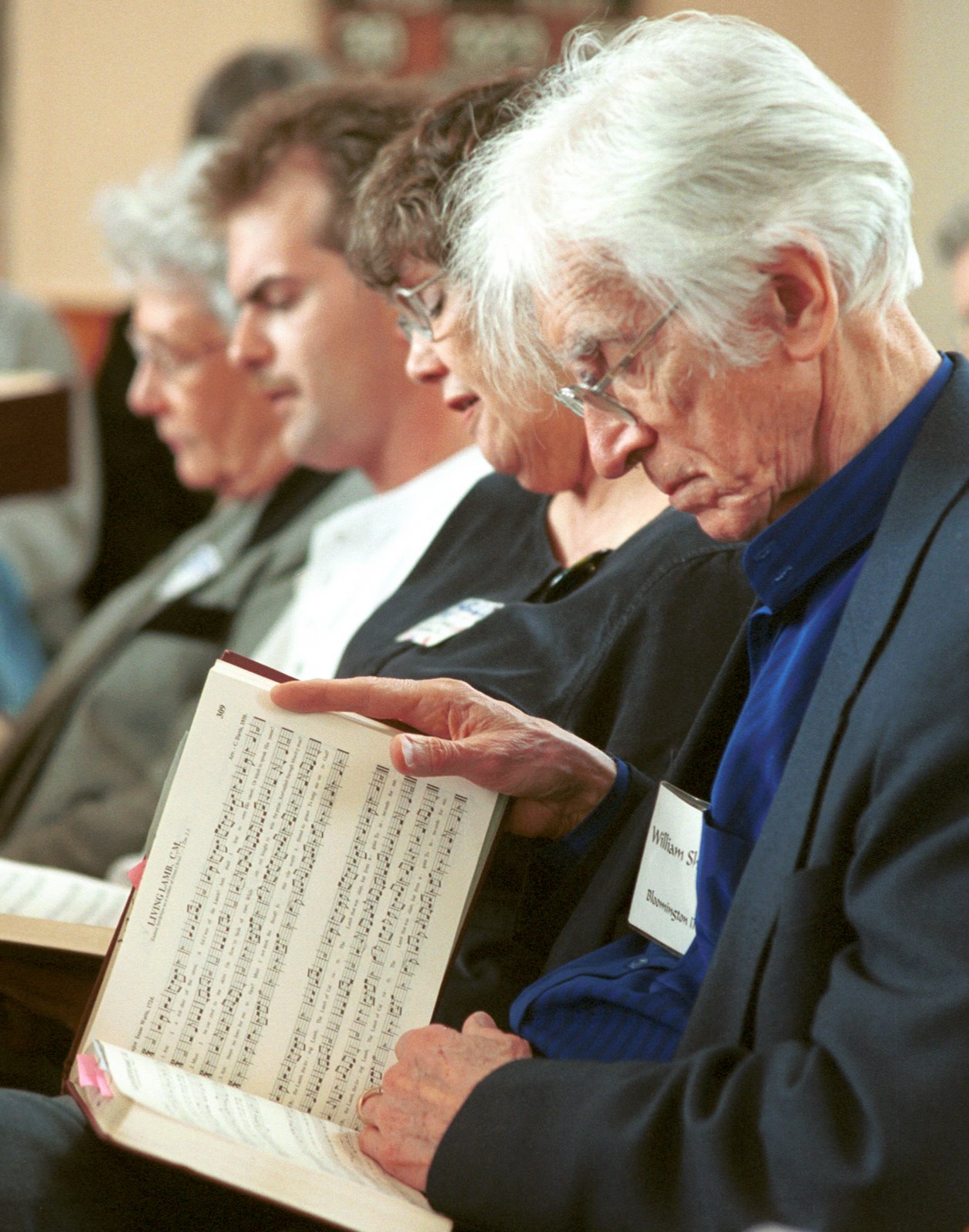
William Shetter, Bloomington, Ind., sings song 308-Parting Friends (Second) on Saturday, March 10, 2001 during the sixteenth annual Missouri State Sacred Harp Singing Convention at the St. John's United Church of Christ in Pinckney, Mo.
 PINCKNEY, Mo.--A stone's throw north of the Missouri River, where Highway 94 crosses a one-lane bridge and wends its way across the rich bottom land toward Jefferson City, shines a white country church against the muted background of late winter.
Here, beneath the peaked roof of the 131-year-old St. John's United Church of Christ, time stood still for an eclectic group of singers who practice an archaic form of music known as Sacred Harp.
"It expresses your feelings about God, about how it feels deep down inside your heart,"explained 48-year-old Alice Moran, who was one of a handful of Joplin-area singers at the two-day convention.
Others, however, said religion isn't necessary.
Gary Gronau, a 57-year-old folk music fan and self-described '60's civil-rights activist from St. Louis, cited the music itself as the biggest draw.
"In this room there are a lot of people who are very strongly religious, and then there are people who are atheists--like me," he said.
Unlike most forms of music, which are intended for an audience, Sacred Harp is meant to be experienced. Harpers sing primarily for the joy of singing, said Gronau, and he repeated a quote attributed to legendary Georgia singer Hugh McGraw: "I will travel across the country to sing Sacred Harp, but I wouldn't walk across the street to listen to it."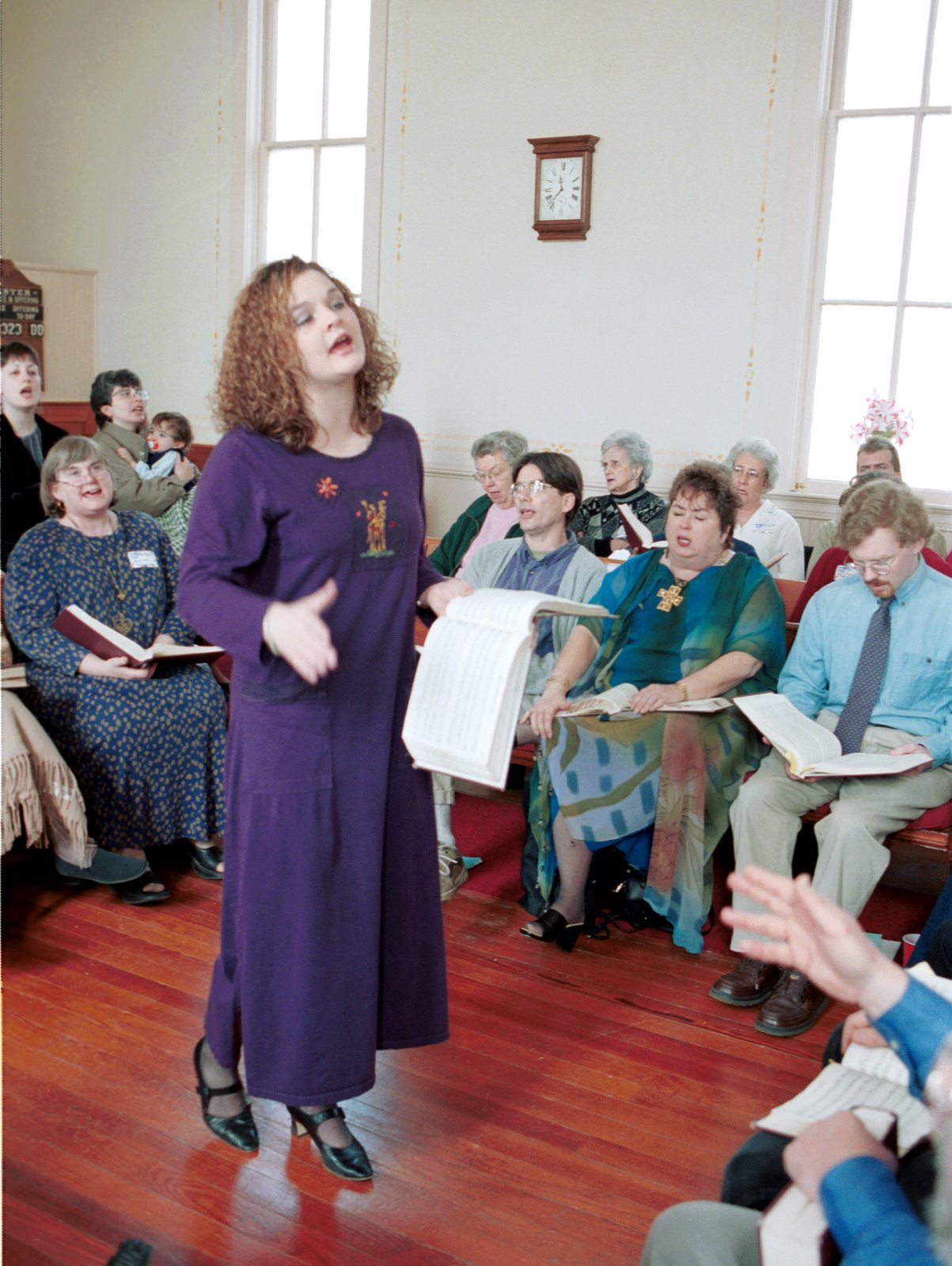
Hollow square
For the uninitiated, the sound can be unpleasant. The lyrics are difficult to understand, unless a printed version is handy, and the seating arrangement of the singers is unlike that of any other kind of performance; unless you're participating, you're looking at their backs.
Members of the congregation sit in what is traditionally called a "hollow square," facing one another, and the music is divided into four parts, from bass to treble, with the melody carried by the tenors.
Song leaders stand in the center of the square and announce songs by calling out their page numbers from the most recent revision of the 1844 book, which stays open on the laps of most. Before they launch into a song, the leader has the group "sing the notes" of the melody while naming the shapes: "fa, sol, la." Pitches are adjusted to meet the needs of the group, so songs may or may not be sung in the keys in which they are written.
The leaders keep time with their hands, turn to coax the best performance from each section, and sometimes scold unruly children at the edge of the group with a well-aimed look. Meanwhile, the singers beat time with their feet, sing as if their lives depended upon it, and often are so swept away by the experience that their faces are portraits of joy.
Near the center of the group, the music not only leaves your ears ringing but can be felt thumping in your chest and abdomen. Veteran harpers tell a tale, perhaps apocryphal, that someone once measured the sound inside the hollow square and came up with a reading of just over 100 decibels--which approaches the level of an average rock concert, at least from a few rows back.
But volume is only one characteristic of Sacred Harp.
Instead of the usual triads found in religious music, the chords are filled with octaves, fourths and fifths. There is also the occasional discordant note, which somehow contributes to the power and also manages to send chills down your spine.
"It's way cathartic," Gronau said.
Primal appeal
Named for an 1844 book that collected the popular ballads and church hymns of the day, the Sacred Harp-style is sometimes called "shape note" because of its primitive system of notation.
 Although the tradtions began in New England, it quickly spread to the Midwest and antebellum South. Singing masters would travel from town to town, give lesson, and largely make their living by the sale of the oblong tune books such as "The Sacred Harp."
Their method taught musical sight reading by combining solmization, or syllable singing, with a notation system of four shapes that represent intervals instead of absolute pitches: triangle, oval, rectangle and diamond.
The advantage was that students unschooled in tradtitional musical notation could learn to sight-read quickly. Also, in the days long before television took the place of the family hearth or village well, the singing schools were an important social function.
"The singing master often appeared with a blackboard, charts showing tonal steps and their changes with keys, a pointer, pitchpipe, an armful of tune books, a love for music, and an earnest desire to teach people to sing," writes Shirley Bean, an associate professor of music at the University of Missouri-Kansas City, in the introduction to "The Missouri Harmony," a collection of 1820's frontier hymns reprinted recently by the University of Nebraska Press.
"The hopeful scholars brought firewood, slates or lapboards, candles, and an eagerness to learn the art of singing. The candles were sealed to the corners of the slates or boards to supply light. Seating was usually arranged in a semicircle severals rows deep. Instruction commenced with a presentation of the rudiments of music. . .soon the group was given exercises in voice placement."
Although most of the songs are religious in nature, some are ballads or commemorate events contemporary to the tune books. Some are unabashedly patriotic.
The spirits of Washington, Warren, Montgomery / lookdown from the clouds with bright aspect serene, begins a tune called "The American Star," which cites a trio of Revolutionary War heroes. Come, soldier, a tear and a toast to their memory / Rejoicing they'll see us as they once have been.
Other tunes can be described only as somber, even morbid.
Remember, you are hast'ning on / To death's dark, gloomy shade, the young are warned in "New Topia. " Your joys on earth will soon be gone / Your flesh in dust be laid.
"The words are imortant," observed Karen Isbell, a former president and founding member of the St. Louis singing group. "They're from a time when life was brutal. People had a different view of God and religion back then--primal, really stark and stripped down--and frankly, I think that's part of the appeal. Life mattered."
Rediscovery of style
While the music eventually died out in New England and the Midwest, it was passed uncorrupted from generation to generation in Primitive Baptist and other churches in the deep South. When a revival of interest in Sacred Harp music began around 1983 in places like Chicago and St. Louis, it was the Southern harpers who eventually showed the newcomers how to sing it full bore.
"We had been struggling along on our own," said Gronau, another founding member of the St. Louis Shape Note Singers.
At first, the members passed around barely legible photocopies from the original tune books, met in attics and basements, and tried their best to conjure the magic the printed matter only hinted at. Then, it occurred to Gronau to seek out those who had grown up in the tradtion, in much the same way blues fanatics had scoured the Mississippi delta seeking links to Robert Johnson and other masters. The result, Gronau said, was a rediscovery of a style that was "crisp and clean."
Also, Gronau learned, Sacred Harp is nothing short of a subculture based on a sort of musical communion, and bolstered by a tradition of shared meals and old-fashioned sensibilities. Harpers may travel across the state to attend a one-day "singing," or across the counry to attend one of the two-day state conventions like last weekend's 16 Annual Missouri Convention at Pinckney, for which the St. Louis group was host.
One of the new singers was Steven Henness, 28, a postgraduate student at the University of Missouri in Columbia. Henness, who holds a master's degree in rural sociology, had been traveling the state gathering information for a research project on community development when he heard of the upcoming convention. Although he attended because of his academic interest in rural tradtions, he soon found himself in the tenor section, singing from a copy of "The Sacred Harp."
"It was both exhausting and energizing at the same time," Henness said. "Instead of just trying to mechanically hit each note one after the other, I found myself being lost in the rhythm and power of the thing."
Also, Henness, the reason Sacred Harp is growing in popularity may be that it allows individuals "to ground their identities" in a tradition that is bigger and older than themselves. This, he said, is becoming increasingly difficult in a world that keeps changing faster than our forefathers could have imagined.
"I was not raised in this kind of tradition," said Elizabeth Senger, who drove with her family from LaCrosse, Wis., to attend the convention. "I was at a folk festival and I heard this stuff at a distance. I was curious, went to take a look, and somebody put a book in my hand."
For Senger, her faith is part of the experience.
"I find I worship better here than in my home church," she said. "There is a power to this kind of music that you don't find in popular culture. You feel connected to people that lived a hundred or more years ago. This morning, for example, we sang about the death of George Washington."
Another attraction, Senger said, is the democratic nature of the event: Song leaders are male and female, young and old, religious and not.
"You know, you hear people talk a lot about jazz as the only style of music that is native to America," she said. "Well there's this, too."
Popular gospel song has uncertain origin
Of all the songs in the Sacred harp tradition, the most popular is a simple tune called "Amazing Grace." Listed at the top of Page 45 of "The Sacred Harp," an 1844 collection of hymns, the song is titled "New Britain."
Many of the tunes in the collection are named for locations that have little to do with the lyrics, but which may reflect the titles of older melodies to which the words were grafted. The origin of the music for "Amazing Grace," however, is uncertain.
The words were written by John Newton, a former slave ship captain. By his mid-20's Newton was engaged in the horrific trade, in which slaves were packed into ships like cordwood and traded in the New World for sugar and molasses, which were taken back to England.
On May 10, 1748, Newton appealed to God to steer his ship safely through a violent storm. Just when it seemed the ship would sink, Newton uttered a simple request: "Lord, have mercy upon us." Although his prayer was answered, he continued in the slave trade for several more years, but gave it up because of ill health and eventually becme a minister in the Church of England.
At Olney, Newton became friends with the poet John Cowper, who helped him with his services. Together, they resolved to write a new hymn for each weekly service and prayer meeting. One of the hymns that resulted was "Amazing Grace," and it was first published in 1779.
Newton wrote several hundred other hymns and kept extensive journals, which have provided many modern historians with a glimpse of the 18th century slave trade. He died Dec. 21, 1807, in London, at the age of 84. Ironically, the "wretch" who once could see had gone blind.
The tune "New Britain" first appeared in a book published in 1829 in Cincinnati, Ohio. Since that time, more than 24 different tues have been published for "Amazing Grace," although many are variations of the one found in "The Sacred Harp."
The first stanza found in many contemporary hymnals, which begins "When we've been there ten thousand years," was not penned by Newton. It first appeared in 1909 and appears to be from an anonymous English folk hymn.
Newton's final stanza:
The earth shall soon dissolve like,
The sun forbear to shine;
But God, who call'd me here below,
Will be forever mine.
Photo captions, from top to bottom:
The hollow square as seen from the balcony of St. John's United Church of Christ in Pinckney, Mo. on March 10, 2001. This was the sixteenth annual Missouri State Scared Harp Singing Convention. From the left, basses, tenors, trebles and in front of the altar, altos.
Cassie Franklin, Henegar, Ala., leads the class in song 222-Ocean on Sunday, March 11, 2001 during the sixteenth annual Missouri State Sacred Harp Singing Convention in Pinckney, Mo. at the St. John's United Church of Christ. She sang both a solo unaccompanied song, Lady Margaret, and as a member of the Sacred Harp Singers for the soundtrack of the movie Cold Mountain released Dec. 25, 2003.
William Shetter, Bloomington, Ind., sings song 308-Parting Friends (Second) on Saturday, March 10, 2001 during the sixteenth annual Missouri State Sacred Harp Singing Convention at the St. John's United Church of Christ in Pinckney, Mo.
Sunday, September 16, 2007
Lowell Davis
 Okay, enough death and destruction photos. Let's change the tone a bit -- here's my friend Lowell Davis, sitting on the porch of his cabin near Carthage and looking reflective. Lowell is an internationally-known artist and the subject of a documentary I've been shooting for a few years now. I took this photo July 27, 2005. What's amazing about Lowell is that he's recreated around him the town of his boyhood. No kidding. He grew up at Red Oak, in Lawrence County, Missouri, and he loved it so much that he has built his own version (called Red Oak II) east of Carthage. There's a feed store, a church, a gas station, a fire department, a Civil War-era cabin or two, and much more. It's not an exact duplicate, but is rather "reimagined" with Lowell's pronounced sense of whimsy. Below are examples.
Red Oak II Fire Truck and Church
 Lowell's fire truck with the Red Oak II church in the background. Note the cross atop the steeple. It's been that way for at least seven years. And yes, it is a working church -- they have services every Sunday and an occasional wedding.
Red Oak II Gas Station
 How cool is this? Although this is an authentic Phillips 66 relic, it is definitely a "no service" station. Lowell is an incredibly nice and talented guy and, by sharing his childhood, he's given spread a lot of joy.
Red Oak II MIL House
 This is the Mother-in-Law's House -- tiny, uncomfortable, and perched precariously over a pond. The detail just knocks me out. Lowell has spent thousands of hours on each of the thirty or so buildings at Red Oak II. All of this is just an incredible feast for a photographer.
Monday, August 27, 2007
So long, J.D. Cash
 Earlier this year, I was asked by Mother Jones magazine for permission to use a photo of investigative reporter J.D. Cash that I had taken back in 2004 at the state trial for Oklahoma City bomber Terry Nichols. Never heard back from the magazine after transmitting the photos, but found online that they story had run in last month's edition of the magazine.
I read the story and was shocked to learn that Cash had died in May. Fuck. This is not the kind of entry I envisioned when I began this blog.
The photo abovet was taken March 22, 2004, outside the courthouse at McAlester. I covered the trial for the British magazine, Fortean Times, in a story called "White Noise."Cash -- who wrote investigative stories for the tiny McCurtain Gazette -- was featured in the article. He had gained notoriety by questioning whether Nichols and Timothy McVeigh had acted alone, or whether a group called the Aryan Republican Army was also involved. I had also done some original reporting on the ARA, and they kept a safehouse at my longtime hometown of Pittsburg, Kansas.

The Pittsburg safehouse is at left, in a photo I took in February 2004. The ARA robbed at least 22 banks across the Midwest and were the poster children for white supremacist nutjobs - they were attempting to finance an all-out race war. The gang was led by boyhood friends Pete Langan and Richard Guthrie. Timothy McVeigh, who was executed for the OKC bombing, may have beena wheel man for the gang. When Langan was outed as a cross-dressing transexual, the gang fell apart. Guthrie and Langan were caught by the feds in 1996; Guthrie committed suicide in prison and Langan is now serving his time at the Supermax prison at Florence, Colorado.
Cash dieda couple of days after the Greensburg tornado, so I was otherwise occupied. But I still feel badly that he died and I didn't know about his passing. He was a terrific guy, and in addition to writing for the Gazette, he also did a local program, and he had me on as a guest a time or two promoting some book or another. Probably The Moon Pool.
Here's what the Associated Press ran on his death:
Published: May 07, 2007 4:55 PM ET
TULSA, Okla. (AP) Newspaper reporter J.D. Cash of the McCurtain Daily Gazette has died at age 55. Cash died at a Tulsa hospital Sunday following after suffering from liver disease and pneumonia.
Cash had spent the past 12 years reporting on the Oklahoma City bombing, including a report from a woman who said she was an undercover agent who warned the government of plans to bomb federal buildings in 1995.
He's survived by his mother.
A private funeral service is planned in Tulsa.
Cash did not have a journalistic background. He came to reporting for one story, and one story only: the Oklahoma City bombing. He did it better than anybody else, he did it for a newspaper with a circulation so small that most journalists cited it with a chuckle, and he came closer to the truth than anybody else. Damn.
And come to think of it, Mother Jones never paid me for the photo. But maybe they didn't use it. Also, J.D. never told me he was sick. But then, as tough as he was, he wouldn't. But I'm glad to have known him, and glad to have taken a photo that tells his story -- outside a courthouse, notebook and pen in hand.
Wednesday, August 22, 2007
Greensburg Neighbor
 I love old trucks, and this one -- carrying an appeal for the "Neighbor to Neighbor" fund in Greenburg -- caught my eye. It was parked at the southeast corner of U.S. 54 and Main Street, at what used to be the center of town. The website for the fund is:
www.neighbor-to-neighbor.net
Big Well Sign

 A donation jug on the chain link fence surrounding the Big Well site. Above, the Big Well sign autographed by workers and others attending the Aug. 4 rededication ceremony. Click on the photo for the larger version, and you can read the names.
Subscribe to:
Posts (Atom)