Thursday, March 3, 2011

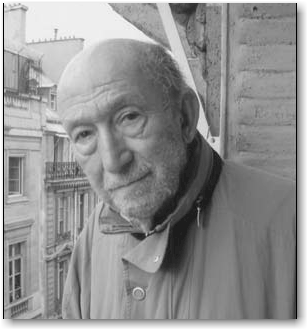
Walter Zacharius: A man among sharks

This bit of sad news from our friend Gary Goldstein, senior editor at Kensington Books:

Walter Zacharius, founder and former CEO of Kensington Books, passed away this morning at the age of 89.
Kensington was founded in 1974 by Mr. Zacharius, who previously had been one of the founders of Lancer Books. Walter started Kensington with a little capital and a big dream. In the 36 years that followed—a little fish in a big pond (and one filled with sharks)--Walter defied all the odds and  built Kensington into a major publisher with a number of current and past NY Times and USA TODAY bestselling authors, among them Fern Michaels, Lisa Jackson, William W. Johnstone, and many others. He also discovered a good number of authors who would go on to have careers at many of the major publishing houses, including Simon & Schuster and Random House.  Kensington currently has close to 100 full time employees and publishes and distributes more than 400 titles a year in mass market, trade paperback, and hardcover.

But it was the western that was, and continues to be, a big part of Kensington’s success. From Zane Grey to Ernest Haycox to Johnny D. Boggs and  Max McCoy, Kensington did ‘em all.  And when conventional wisdom said that the western was all but dead as a category, Walter reacted as he always did—he charged head-first into the category and filled the void left by the other publishers. With great success.  Till the end, Walter was a huge supporter of the western and of the  WWA. When Richard Wheeler won the Spur Award for Vengeance Valley in 2005—Kensington’s first such honor in more than three decades of publishing Walter was so proud  that he displayed the publisher’s plaque on his office wall right next to a picture of his grandchildren.

The plaque is still there.

Walter Zacharius was the last of a breed—a maverick  independent in an industry now run by corporate wonks.

Sunday, February 27, 2011

Sixth Rider featured in Kindle Reader Blog

The Sixth Rider 20th Anniversary Edition (a Kindle ebook) has been featured in Jan Zlenditch's Kindle Reader  Blog. I'm in good company, because she also mentions Elmer Kelton in the same post (and Joyce Carol Oates elsewhere). Here's the link.

Saturday, February 26, 2011

"These long-tailed heroes of the revolver"

Deadly Dozen: Forgotten Gunfighters of the Old West, Vol. 3
By Robert K. DeArment (University of Oklahoma Press, 2010) Hardcover, 396 pp.

Robert K. DeArment has given us a third volume in his meticulously researched series on “forgotten” gunfighters of the old west, although some of his subjects – Charley Harrison and Ed Short, to name two – will be familiar to western history buffs. Others, such as Jewish gunman Jim Levy and the maniacal Hill Loftis, will offer new and wicked delights.

A foreword by historian Roger McGrath explains that DeArment himself has some experience with handling a gun, as a soldier during World War II. “He understands that there is nothing more dramatic than a man fighting for his life and nothing more courageous than a man hearing the snap and crack of bullets about his head yet cooly and deliberately returning fire.” This may help explain why DeArment isn’t given to the hyperbole and hero worship that has infected other nonfiction writers on the same subject. What we get from DeArment is the unadulterated truth, culled from an exhaustive sifting of the historical account, and presented in a logical and straightforward manner. With each of the dozen subjects, we get a brief family history (often, the second paragraph recounts their birth) followed by a detailed account of their gunfights and their immediate or eventual deaths. Of the dozen subjects, most met violent ends. Six died in gunfights, two were dead by suicide, and one was lynched by a mob. Only two died of natural causes, and the fate of another is uncertain.

In setting the scene for an early Nevada pistoleer named Farmer Peel, DeArment gives us a bit of Mark Twain in describing how gunmen were regarded in the silver camps: “The desperado stalked the streets with a swagger graded according to the number of homicides, and a nod of recognition from him was sufficient to make a humble admirer happy for the rest of the day… When he moved along the sidewalk in his excessively long frock-coat, shiny stump-toed boots, and with dainty little slouch hat tipped over left eye, the small fry of roughs made room for his majesty,” Twain recalled in Roughing It. “The best known names in the Territory of Nevada were those belonging to these long-tailed heroes of the revolver.”

Farmer Peel (who was given the nickname by his peers because he looked nothing like a farmer) died on in Montana in 1867, during a gunfight with gambling rival John Bull. Peel was walking arm-in-arm with his mistress when, according to one account, they were confronted by Bull with pistol drawn and murderous intent. But Peel could not jerk his gun hand loose from the frightened woman’s grasp quick enough to defend himself, and Bull ended the dispute with three bullets – the last fired into Peel’s head at point-blank range.

In recounting the life of gambler Charley Harrison, DeArment does a good job of portraying the rip-roaring days of early Denver and Harrison’s death, as a Confederate officer, after a running fight with a band of Osage on the Verdigris River in southeast Kansas. As for lawman Ed Short, the author gives us a sober account of his killing in a toe-to-toe shootout in a Rock Island mail car with a member of the Dalton Gang. But DeArment truly shines when he recounts the life of Jim Levy, the only known Jewish gunman in the west.

Levy, a professional gambler, gained fame for his drunken and deadly shooting matches in gambling halls from Deadwood to Tombstone. After an argument with a fellow sharp in Tucson, Levy – who was flat-broke and perhaps mentally unstable – agreed to end the quarrel with a duel across the border into Mexico, and a hat was passed to raise thirty dollars to pay for a wagon to convey the combatants and their entourages. But the law got wind of the fight and spoiled the fun. But that wasn’t the end of it; the other fighter and two of his friend ambushed Levy when he emerged from a Tucson hotel. Levy fell dead on the sidewalk, and a newspaper reporter on the scene claimed he was unarmed. Levy was forty, rather old for his line of work.

But the story of Hill Loftis is perhaps the most disturbing of DeArment’s dozen.

Loftis – who also went by the aliases Tom Ross and Charles Gannon – had a rap sheet that ran from the Old West to the eve of the Great Depression. He was part of the Red Buck Waightman Gang that attempted robbery and successfully pistol-whipped the owner at Waggoner’s Store in Oklahoma Territory on Christmas Eve, 1895, and later holed up in a dugout and fought it out in the bitter cold with a posse of lawmen. But Loftis escaped, and remained a fugitive for many years, spending some time in South American but eventually returning to the states. Loftis was apparently easy to spot, having a head shaped like a buffalo’s and chilling black eyes. One Texas Ranger who chased him even believed that perhaps the outlaw’s peculiarly elongated head “caused some pressure on the brain, and might account for his vicious tendencies.” Loftis was convicted of murder in Texas, but later broke prison. He remained on the run until 1929, when during a thirty degree below night in a Montana line camp he killed a range detective by the name of Ralph Hayward who had been sent to smoke him out. After shooting Hayward to death, Loftis ordered the other cowboys out into the cold, burned all personal papers, and wrote a suicide note – then put a pistol to his head and pulled the trigger.

With this volume, with its copious notes and thorough index, DeArment has once again added to the body of Old West scholarship. He has also provided solid entertainment for the casual reader looking for something fresh amid the stale and often-told tales from the outlaw trail.
Thursday, February 3, 2011

Snow day

The university was closed for two and one-half days for snow and bitterly cold temps. Here's a shot of Plumb Hall, where I work. Made the photo yesterday on my way back from the student newspaper. The staff was composing this week's issue (they made deadline, the campus opened this morning, and the paper was delivered this afternoon). As I told the students, there are no snow days for journalists.

Monday, January 31, 2011

Dig this


Here's a photo of me taken by my journalism student, Kellen Jenkins. Kellen is a senior at Emporia State and is a part-time shooter for the Topeka Capital-Journal and the Emporia Gazette.

Saturday, January 29, 2011

Try it, for free

Had a friend ask me the other day if western readers would actually buy a Kindle book. Aren't these the kinds of things that you find in truck stops and in wire carousels near the checkout in super markets? Well, sure. I've got a copy of CANYON DIABLO on my shelf because I found it for sale at Reeble's Country Mart, not half a block from my door (and that really is kind of cool, because I wrote the book here at home, shipped it off to the publisher in New York, and it came back to my neighborhood supermarket as a finished project). But, I also found multiple copies of my latest book, DAMNATION ROAD, at the Barnes and Noble in Topeka -- a very respectable venue, complete with coffee shop. And, I told him, giving my usual disclaimer, that my books aren't really westerns. I think of them as simply novels, but some fans and critics like to call them western noir, a term I won't disagree with. So, I think the a Kindle books are entirely appropriate for my work. You can get HELLFIRE CANYON, which was named a 2008 Kansas Notable Book and won the Spur Award for best novel, as a Kindle. You can also buy the Spur Award finalist, I, QUANTRILL, for your Kindle. THE SIXTH RIDER 20th ANNIVERSARY EDITION has just been released. If you don't have a Kindle, you can download a free application from Amazon that will let you read the books on your computer. And to make it even more risk free, you can try before you buy -- you can download sample chapters of any of these novels for free, with no obligation to buy.

Sunday, January 23, 2011

'Small price to pay for beauty.'


More nostalgia. The first edition, Doubleday, 1991. I remember what a thrill it was to go into libraries across the country and find the book in card catalogs. Of course, in those days the card catalog was a nice wooden cabinet with actual index cards, with the bibliographic information and call number neatly (or not so neatly) typed. For a writer, it was the purest form of validation. Now, card catalogs are electronic, and you're staring into a computer screen instead of feeling the edge of the cards riffle beneath your fingertips. Progress, I know. Reminds me of a line from Butch Cassidy and the Sundance Kid:  "What happened to the old bank? It was beautiful."

Mass market Ken Laager cover


A bit of nostalgia: The cover of the mass market paperback edition of The Sixth Rider, 1994. The illustration is by Ken Laager, a terrifically talented artists who was known at Bantam for his "western fine art look." It is a particularly good cover, I think. Laager is now a gallery painter, and you can see more of his work at www.kenlaager.com. Go to the Illustration section, and take a look at a work called "Quantrill's Raiders," an illustration he did for the cover of my second book.

Sixth Rider Kindle Edition

The 20th Anniversary Edition of The Sixth Rider is now available on Kindle, with a new cover and an afterword by Johnny D. Boggs. The novel was first published in hardcover by Doubleday and here's the inside jacket copy:

It's late in the last century and the Wild West is becoming tamed by telegraph wire, railroads, and the modern methods of federal lawmen. But the Dalton boys, kin to the infamous Younger and James clans, haven't heard the news. Brought up on romantic tales and songs about outlaws, they aim for glory and gold, following in the bloody footsteps of the legendary gangs of the West.

Samuel Cole Dalton is the youngest of fifteen children sired by a drunk and raised by a Bible-reading Kansas woman whose love can't keep her brood on the straight and narrow. At thirteen, Sam still has a chance at an honest life, but his fate is decided when he witnesses the cold-blooded shooting of his brother, Frank, by the moonshiner William Towerly.

Sam takes off after Towerly, bent on revenge. His only resources are his youth, his fury, and the remarkable shooting skills that are the Dalton inheritance. Tracking Towerly to a mountainside hideout, Sam blows away two bandits, but his real quarry escapes. An Indian girl is chained in the cabin, kidnapped by Towerly, and Sam returns her to her home in the Choctaw Nation.

Sidetracked by his love affair with the girl, it is over a year before Sam, now known as the "Choctaw Kid," meets up with his brothers, Bob, Grat and Emmett. The Dalton Gang goes into business: rustling, robbing, and running from the law. But even as they achieve the renown and riches they craved, Sam can't find the fabled glamour of the outlaw life anywhere. Their last heist is a battle famous in Western history, as legendary as the story of the sixth rider--the Choctaw Kid--who manages to escape the violent fate of the notorious Dalton Gang.

Thursday, January 20, 2011

Iconic images


The Iconic Kansas photo exhibit opened at the new Emporia Arts Center last night, just in time for the state's sesquicentennial on Jan. 29. Sixteen artists are represented, including the work of my friends Phillip Finch and Kara Wolford. That's Kara at left, discussing photography with juror Jim Richardson. Richardson, a native Kansan, is best known for his National Geographic work -- especially his three decades of chronicling Cuba, population 231, in extreme north central Kansas. The Emporia exhibit began in 2007, when the Center for Great Plains Studies launched the Plains Photo Project. Special thanks to Jim Hoy, the director of the Center for Great Plains Studies; Susan Brinkman, the center's assistant director; and the board and staff of the Emporia Arts Council. Liz Shenk, a former student of mine, hung the exhibit, which runs through March 2. 

Wednesday, January 19, 2011

Aermotor detail

The Aermotor Company, founded in 1888, is a familiar trademark in the west. The company, which is still in business, also produced the Norden bombsight during World War II. The Aermotor plant has moved periodically as the company changed hands, although for many years it was located in Conway, Arkansas. It is now located in San Angelo, Texas. This mill looks as if it tangled with a twister -- and lost.

Quixotic icon

Adjacent to Longhorn Park is this windmill, a plains icon since the late 19th Century. They were used to pump water and, later, generate electricity before rural electrification. I find windmills like this to be more aesthetically pleasing than the turbine giants now invading the windblown plains.  

Tuesday, January 18, 2011

Longhorn Park

Here's the mayor of Longhorn Park, population six (there may be more, but that's all I counted). Longhorn Park's display herd is located at the entrance to the Dodge City airport, a mile east of town on U.S. 50. Despite their fierce appearance, longhorns are reputed to be gentle in disposition and can even be ridden like a horse. Longhorns were common in the west until the 1880s, when they began to be replaced with other breeds, particularly Herefords.

Friday, January 7, 2011

Twenty Years After

Here's a preview of the 20th Anniversary Edition of THE SIXTH RIDER, which will be released soon. This new edition will contain every word of the original Doubleday hardcover, plus new material written especially for the anniversary. This book, which is set against the 1892 raid on Coffeyville's banks by the Dalton Gang, was named Best First Novel by the Western Writers of America. Don't want to give away too much yet... but I'll post more details as they become available.

Thursday, January 6, 2011

"Gambler's Ghost" featured on Coast to Coast

The"Gambler's Ghost" photo has been featured on the Coast to Coast AM website -- and I've been swamped with emails from interested people across the country. Most of them just want to know more about the photo, but a few are sharing their own ghost photos. A dedicated paranormal investigator of Civil War battlefields has said that he believes there has been a rise in capturing ghosts in windows and other glass using digital cameras, owing to the phsyics involved. Maybe. I've been a confirmed ghost photo skeptic up to this point -- I suspected that most of them were faked or, like orbs, were easily explained by dust particles reflecting the on-camera flash back into the lense. But, I took this one, know it wasn't tampered with, and have no explanation. I've even shared it with a scientist friend of mine, who shared it with some of his firends and colleagues, and they were stumped as well. I've enjoyed chatting with my email friends about this. And hey, some of them might even become fans of my books.

Wednesday, January 5, 2011

Saratoga Saloon


The Saratoga Saloon (the location of the Gambler's Ghost photo, previous post) was owned in part by Dodge City Sheriff Chalk Beeson and offered billiards, keno, faro, and poker. It is Location 13 on the Boot Hill Museum self-guided brochure. Beeson, a legendary lawman, also owned a part interest in the more famous Long Branch Saloon. 

Gambler's Ghost

I've debated about whether to post this photo or not, but it is so damned weird that I've finally given it. I made this photo on the afternoon of Wednesday, Dec. 29, through a pane of glass in the Saratoga Saloon exhibit at Dodge City's Front Street. I was focusing on the gambling apparatus (faro, keno and chuck-a-luck) on the table in the foreground. This isn't a great photo, and wasn't meant to be anything other than a research pix, the visual equivalent of scribbling some notes. But, it is unusual in that you can see me holding the camera in the mirror in the upper left, and see that nothing is behind me to cast the ghostly reflection. Also, I was in Dodge City -- and toured the Boot Hill and Front Street exhibits -- to gather research for a proposal for paranormal series set in the old west (a Victorian medium and a bounty hunter teamed up... "Wylde's West," maybe). And just before I took the photo, I thought there was someone in the room with me, and actually turned and looked over my shoulder. What is especially ironic is that every fall semester, I challenge my photojournalism students to come up with a (faked) ghost photo for me to debunk. I tell them there's never been a convincing photo of a ghost, and that if they actually capture one (in a photo I can't explain away), they get an A. I'm sure this photo is just a trick of light, shadow, and reflection,  but still... it is strange. The photo has not been altered or enhanced in any way. The technical info: Canon EOS 10D, 19mm lens, 1/30th second, f 3.5, ISO 800. Life -- and death -- are strange!

Tuesday, January 4, 2011

Somewhat larger than Wyatt


A detail of the Wyatt Earp statue by Oklahoma artist Mary Spurgeon, who began sculpting at the age of 72. Spurgeon grew up near Dodge City and spent most of her life painting. Now in her nineties, Spurgeon lives on a ranch near Gate, Oklahoma, a hundred miles due south of Dodge. The statue, placed in 2004, is near Central and Wyatt Earp Boulevard and wields the long-barreled (and perhaps apochryhal) "Buntline Special" Colt. At eight feet, the statue is somewhat larger than the real Wyatt Earp.

More Boot Hill

There were other Boot Hills in the west -- most notably in Tombstone and Deadwood -- but Dodge City's has a building on site with interpretive displays about the plains tribes, the cowboys, the pioneers, the soldiers, the lawmen, and even Hollywood's influence on Dodge City. Absent, however, is any portrayal of Mexican culture. This is odd, considering the current population is about 40 percent Hispanic, and that when the Santa Fe Trail was blazed in 1822, it quickly became the primary trade route with Mexico. The only mention of Hispanic culture in a self-guided tour brochure available at the visitor's bureau is this entry, for the area that housed migrant railway workers: "The Mexican Village was a small shanty town on the southeast corner of Dodge City in the early 1900s... now buried underneath streets, warehouses and scrap metal."