 There's nobody left in Boot Hill at Dodge City, but it remains the most famous cemetery in the American west. Located on a hill overlooking Front Street, and never intended as an official cemetery, this patch of ground was the final abode for drifters, prostitutes, anonymous buffalo hunters found frozen on the plains, and a few who met bloody ends in Dodge City's saloons. About sixty individuals were buried here before the gravyard was moved in 1879 to a new cemetery northeast of town. "No one famous was ever buried here," notes the Boot Hill Museum Guide. For the admission price of ten bucks (10 percent discount in the off season), you can see Boot Hill and the recreated Front Street.
Monday, January 3, 2011
Boot Hill
There's nobody left in Boot Hill at Dodge City, but it remains the most famous cemetery in the American west. Located on a hill overlooking Front Street, and never intended as an official cemetery, this patch of ground was the final abode for drifters, prostitutes, anonymous buffalo hunters found frozen on the plains, and a few who met bloody ends in Dodge City's saloons. About sixty individuals were buried here before the gravyard was moved in 1879 to a new cemetery northeast of town. "No one famous was ever buried here," notes the Boot Hill Museum Guide. For the admission price of ten bucks (10 percent discount in the off season), you can see Boot Hill and the recreated Front Street.

Saturday, January 1, 2011
Front Street
 Here's Front Street in Dodge City, looking down from Boot Hill. There were actually two Front Streets, one north of the tracks and another south. The tracks were the "deadline," and no guns were allowed north of the line. South of the line, however, anything went -- and often did. Popular interest in Dodge City's past can primarily be attributed to Hollywood, for the 1939 film starring Errol Flynn and the long-running "Gunsmoke" series on television. This (North) Front Street was recreated in 1958, using property records and old photographs. it might have been interesting, however, had they recreated South Front Street instead. Known as the "wickedest little town in America," Dodge City was fueled by the cattle and buffalo trade and roared from 1872 to 1880. The river of legal alcohol stopped when Kansas went dry in 1881; a few years later, the cattle also had stopped coming, the railhead having moved on. The buffalo were close to extinction by that time as well.
Friday, December 31, 2010
Sundial for New Year's Eve
 Let's make the last post of the year about the impressive Mountain Time sundial at the historic Dodge City depot, which signaled railway passengers in years past that they had crossed the 100th Meridian and were officially in the West. There's an identical sundial, a Central Time one, a few yards to the east (although the meridian doesn't run between the sundials -- that line is about a mile to the east, between avenues L and M). Travel Note: Dodge City is on Central Time. Mountain now begins a bit farther west, in Hamilton County.
Best coffee in Dodge
 For me, coffee is as essential to a research trip as a notebook and camera. Here's where I found the best coffee in Dodge City -- Cup of Jo-nes at about Ninth Street and Wyatt Earp Boulevard. The blueberry muffin was also good, and served with fruit on the side. The interior was warm and comfortable after braving the ceaseless wind (photographing) out on the Santa Fe Trail. For eats, the best was Casey's Cowtown Club, a traditional steakhouse at 503 E. Trail (that's south of the tracks and beyond the deadline, for you Dodge City buffs). Sorry, no photo of Casey's, but the steaks and hamburgers were terrific and there's an odd and interesting mix of western art on the walls to browse while awaiting your food. The prices are unbelievably reasonable as well --- the $19 ribeye I had would have been two or three times that price in a major city, and without the home-baked bread and green beans. I have to confess, however, that I was warmly inclined to Casey's when, upon entering, the owner shook my hand and asked where I was from. And no, I didn't tell either Cup of Jo-nes or Casey's that I was, ahem, a writer. The worst food in Dodge City? Perhaps I shouldn't... Oh, what the hell. It was The Inn Pancake House, which served a tired and over-priced breakfast buffet. Curiously, had a hard time finding local places to eat in Dodge City, despite having traversed much of the town. Oh, there were lots of chain restaurants -- including an Applebee's infringing on Front Street, shudder -- but few authentic establishments. Where, I wonder, do the pheasant hunters eat breakfast?
Thursday, December 30, 2010
And the trail itself
 The Santa Fe Trail runs to the upper right.The trail was 1,200 miles and was essentially the path the railroad would later take. This is the longest identifiable section of the trail remaining and has been designated a National Historic Landmark. This photo was taken on Wednesday, and while the temperature was unseasonably mild, the wind was fierce.
More trail...
 Here's the sign from the photo below. Caravans traveled with wagons four abreast, cutting a wide swatch in the prairie for 60 years. "Look for long, wide depressions, different vegetation, and water courses running at odd angles at places were 'bridges' in the path span ruts," the sign advises. "They are easiest to see when the sun is low."
Santa Fe Trail
 About 11 miles west of Dodge City along U.S. 400, there's one of the best remaining places to view the ruts of the old Santa Fe Trail. There's a parking area and a path across the prairie to an observation point where you can plainly see the ruts as they go ever westward. The trail, established in 1822, ran from Franklin in central Missouri to Santa Fe in what was then Mexico. Near this spot is where the trail forked. The Mountain route, cutting across the edge of what is now Colorado, was the safer route. The Cimarron Cutoff, which took off to the southwest across the sand hills of the Oklahoma panhandle, was faster -- but risky, since there was precious little water.
Wednesday, October 13, 2010
Signing Nov. 13
 Award-winning novelist Max McCoy and former FBI agent Mark Bouton will have a signing 11 a.m. Saturday, Nov. 13 at the Town Crier in Emporia to celebrate their newest books. Max's latest is called Damnation Road ($5.99 paperback), which is the latest featuring Rough Rider Jacob Gamble. It's another exciting and savage adventure through the American southwest! Mark's latest is How to Spot Lies Like the FBI ($12.95 paperback), which will teach you how to read body language, facial expression and other tell-tale "tics" that people exhibit when they're lying. Join us from 11 a.m. to 1 pm. and visit with the authors and have your copies signed! And as always, if you can't make it, just give us a call and we'll get books signed for you! -- Thanks to Town Crier, 716 Commercial St., Emporia, Kansas.
Boggs at Ozark Writers
 Johnny Boggs was a keynote speaker at the 42nd annual Ozark Creative Writers conference last weekend at Eureka Springs, Arkansas. We walked from the convention center on Saturday downtown for lunch and back, and at one point I asked Boggs to pose for a photo. Here's the result. Boggs is a four-time Spur winner, the immediate past president of Western Writers of America, and a Wrangler Award winner. He's also a wine snob, I discovered. But he did a great job at the conference, of course. A few years back, I dedicated a book to him, but called him "the bastard Johnny Boggs" as, well, a joke on how nice he is. He told me the dedication cost me a sale -- to his mother.
Wednesday, August 25, 2010
DAMNATION ROAD
 The outlaw Jacob Gamble is back in DAMNATION ROAD. The official release date from Pinnacle is Sept. 7. This is the third and final book of the trilogy that began with the Spur-award winning HELLFIRE CANYON. The year is 1898 and the location is Guthrie, Oklahoma Territory, and points beyond -- geographically, morally, and spiritually. Like the other Jacob Gamble adventures, this isn't your typical genre western. Consider yourself warned.
Monday, May 24, 2010
This blog has moved
This blog is now located at __FTP_MIGRATION_NEW_URL__.
You will be automatically redirected in 30 seconds, or you may click here.
For feed subscribers, please update your feed subscriptions to
__FTP_MIGRATION_FEED_URL__.
Tuesday, March 30, 2010
Wednesday, March 3, 2010
The $46 man
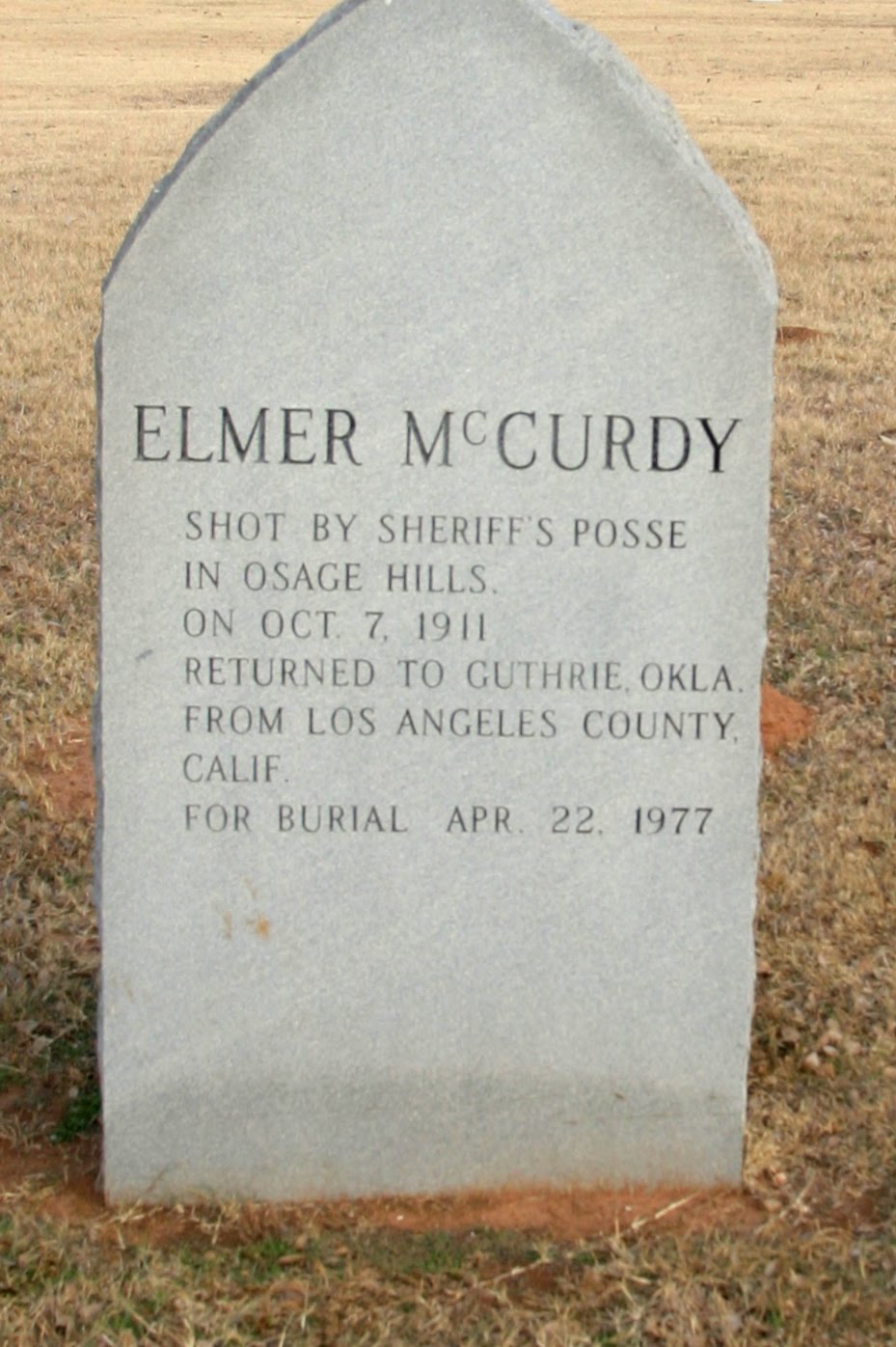 One of Doolin's neighbors in Summit View is a lesser outlaw by the name of Elmer McCurdy, killed in a gunfight with lawmen after a train robbery in the Osage Hills on Oct. 7, 1911. McCurdy's body wasn't buried for another 65 years, however -- his corpse was mummified and spent decades touring the country in carnivals and spookhouses. It was finally identified as human remains at an amusement park in Long Beach, California, in 1976, during the filming of an episode of "The Six Million Dollar Man," and returned to Guthrie for burial. Oh, and what did McCurdy get during that 1911 train robbery? Forty-six dollars and some liquor.
Dead like Doolin
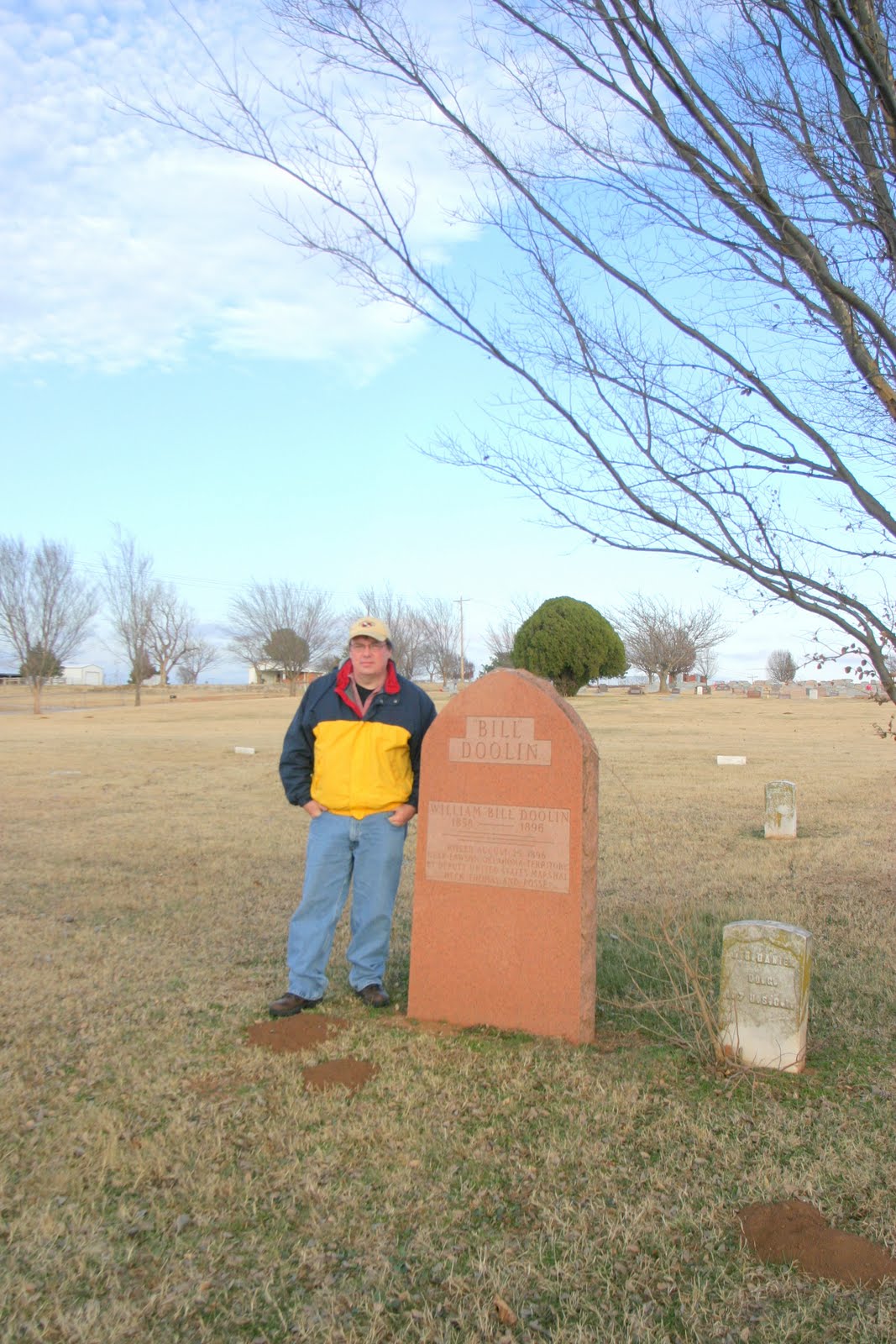 Bill Doolin, Outlaw O.T. (Oklahoma Territory), was killed by a posse led by Heck Thomas near Lawson on Aug. 25, 1896, after escaping from the federal jail at Guthrie a few weeks earlier. Accounts differ as to who fired the fatal shot, but all agree that Doolin was hit with a fatal blast of buckshot from an eight-gauge shotgun. The results were documented by the local photographer, as was the fashion, and for a quarter you could buy a postcard of Doolin in death -- with the proceeds ostensibly going to his widow, Edith, for burial expenses (although none of the money collected went for that purpose). Doolin was buried in Summit View Cemetery at Guthrie, and his grave marked with a bent buggy axle.
Today, Doolin's grave is marked with an impressive red tombstone that is about as tall as I am (see left), in an area marked with a cheesy "Boot Hill" sign in Summit View. By all accounts, Doolin was among the most likeable of western outlaws, and claimed to have never killed anybody during any of his many robberies, at least not on purpose.
Tuesday, December 29, 2009
Territorial prison gallery
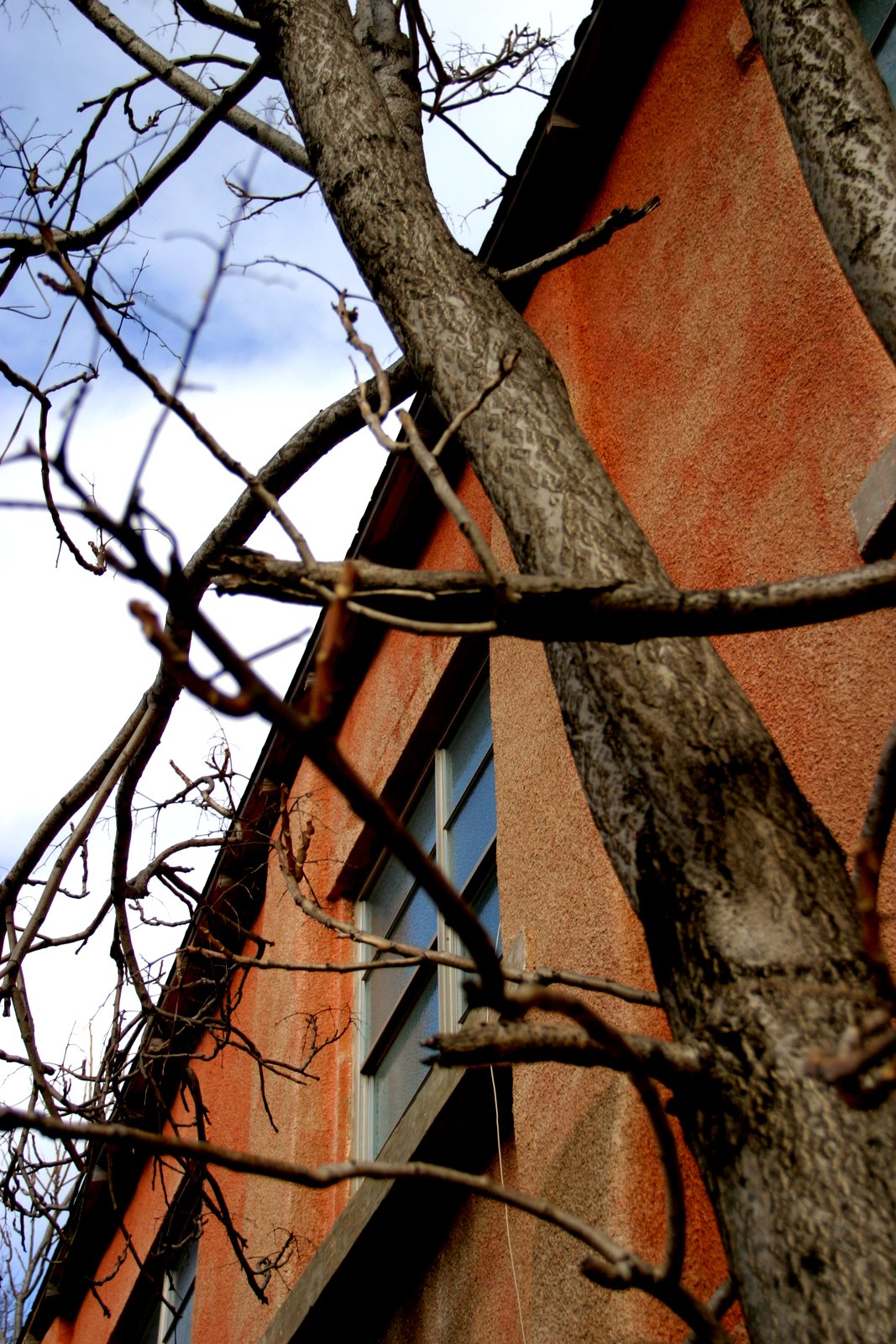 Here's the front of the old territorial prison at Guthrie, on the northeast corner of Second and Noble. This was the place that Bill Doolin escaped from in 1896 -- and which plays a central role in my new novel, DAMNATION ROAD. Underneath that pink stucco, which was added after the local Methodists bought the building for a church in 1924, is native red sandstone. About where you see the window in this photo was the main entrance to the jail, an iron cage attached to the outside of the building that was reached by a flight of steep iron steps. In some of the literature, you see this referred to as the "black jail" of Guthrie, but that was an earlier county jail, which was built from black strap iron. After the Methodists purchased the building, they added the stucco, a peaked roof, and a church-like addition on the east end to make it appear less like a fortress. After it was abandoned by the Methodists, it was home to the Samaritan Foundation, a religious cult, until 1995. The building has been declared unsafe and is closed to the public, although there is an restoration movement planned, according to a sign on the corner of the building. The jail, as you might expect, is reported to be haunted.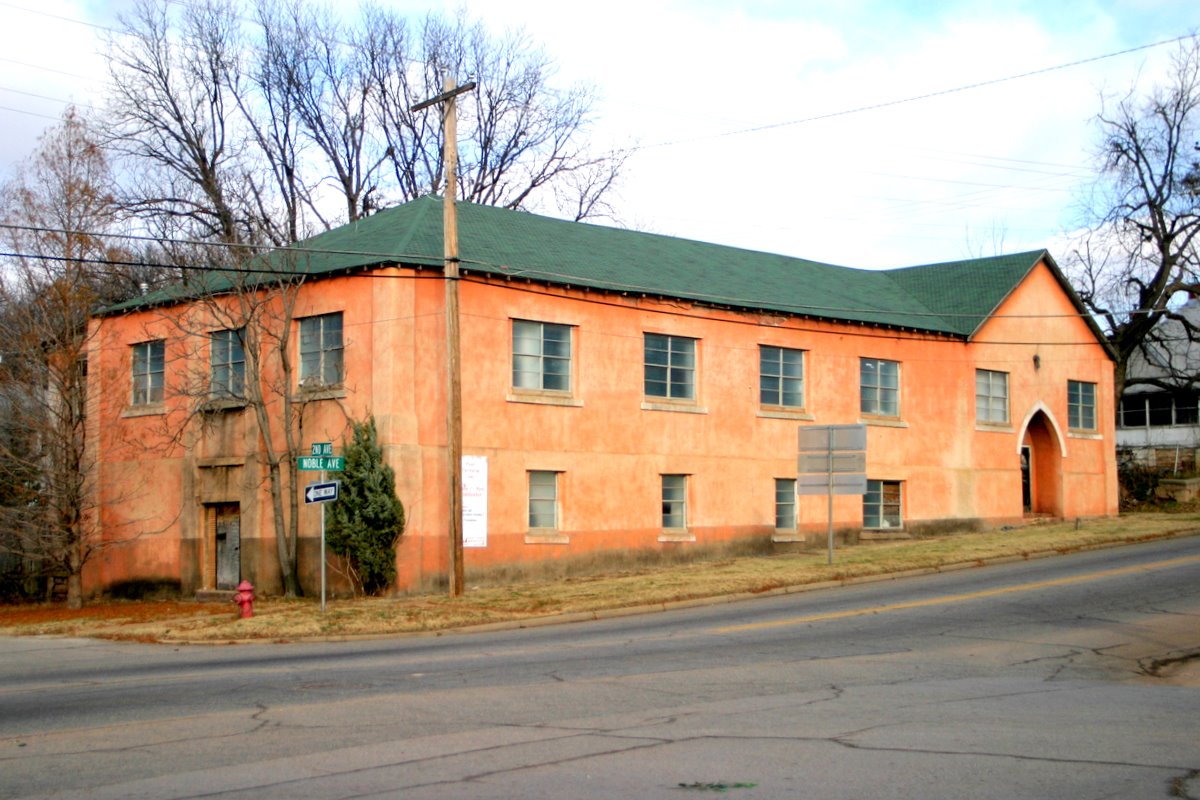
Wide shot
Here's a shot of the entire building. The old entrance is on the left (west) side of this photo, facing west. The original prison building did not have a green peaked roof, nor did it have the church-like addition on the east side.
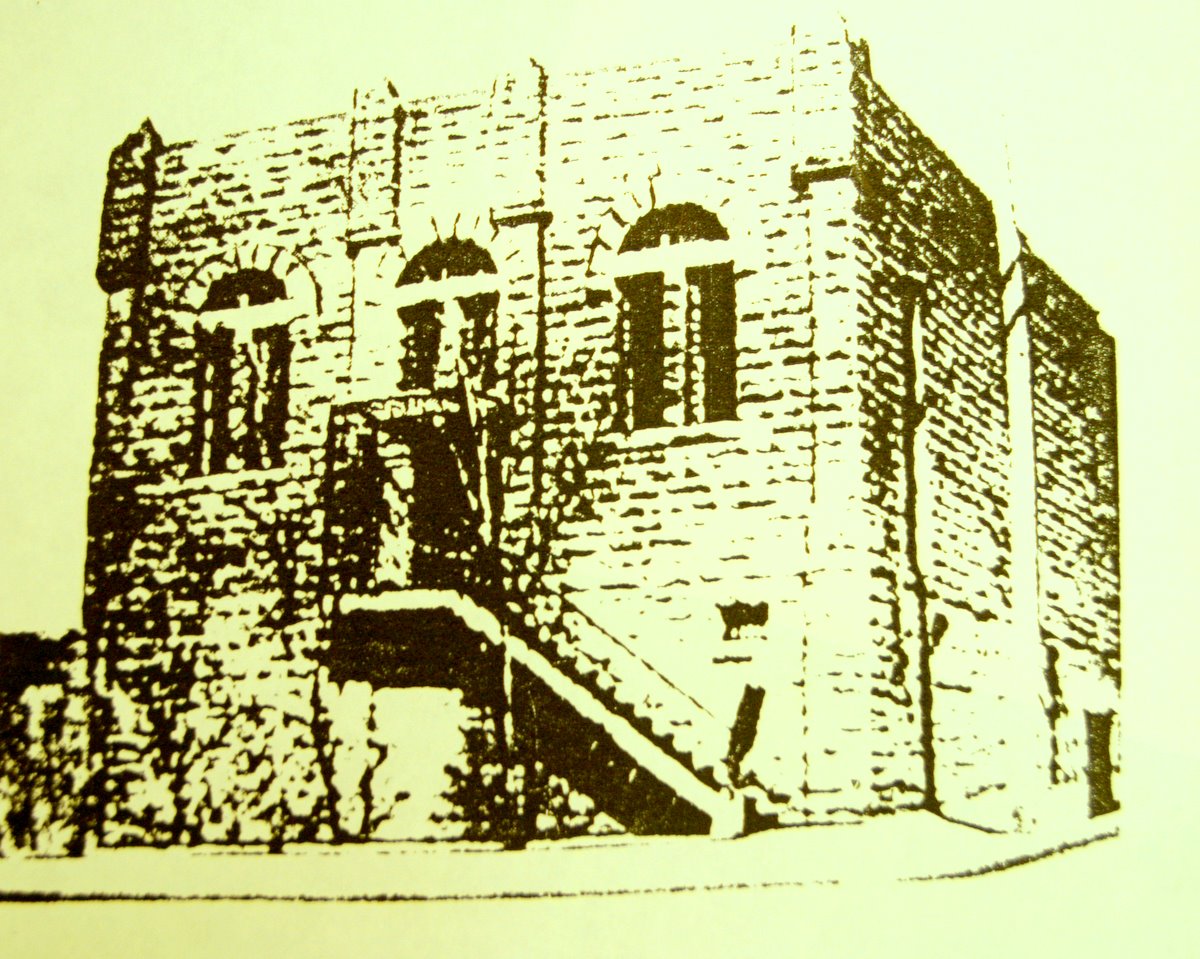 Original building
Here's what the territorial jail originally looked like in the 1890s, from a photo in the Oklahoma Historical Society Archives. Look closely and you can see the steps leading up to the iron cage and main entrance on the second floor.
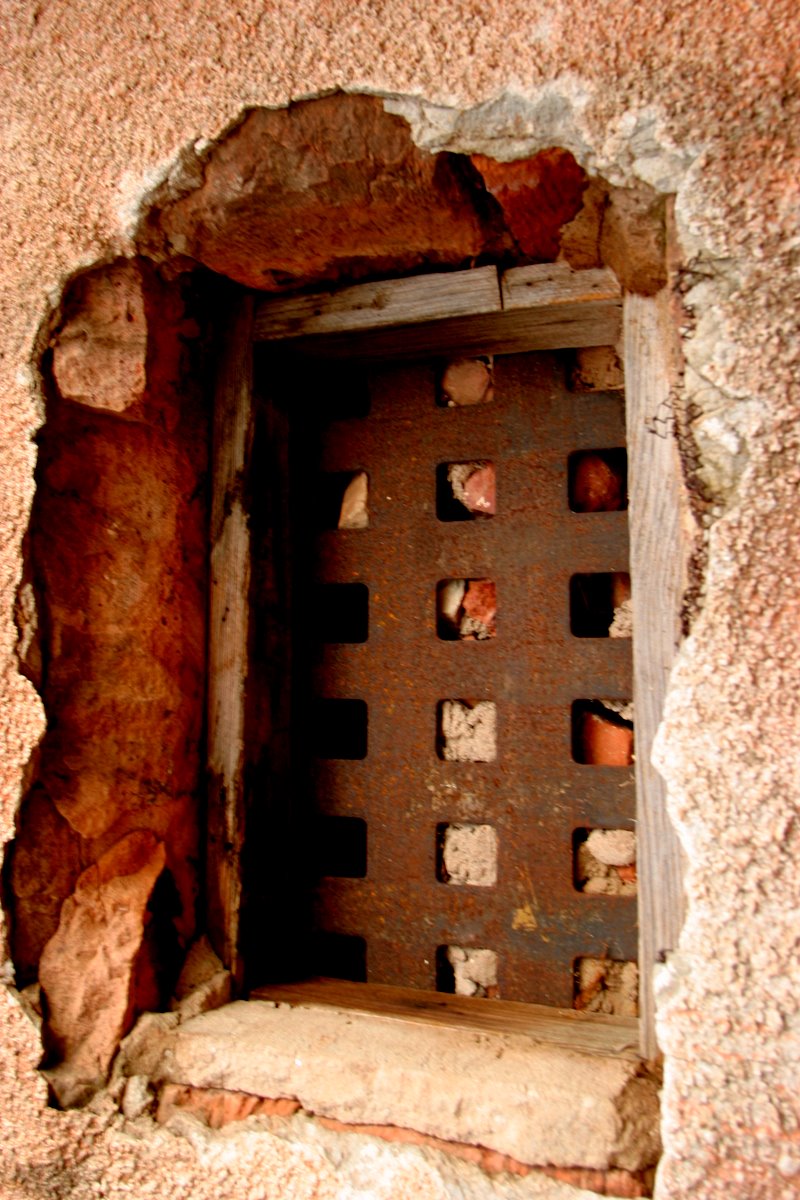 One last shot
Here's a tiny barred window that is on the ground floor of the prison, visible on the old photo just above the bottom of the steps. This was a special cell sometimes used for female prisoners, usually prostitutes, if I'm reading my sources correctly.
Did I encounter any ghosts while visiting the old territorial prison? Well, no. But there was a decidedly weird and malevolent vibe to the place -- but maybe that's just because I knew a little history. Oh, and what happened to Bill Doolin, the famous Oklahoma Territory outlaw who famously broke out in 1896? I'll save that story for my next post...
Friday, December 11, 2009
Holiday shooter
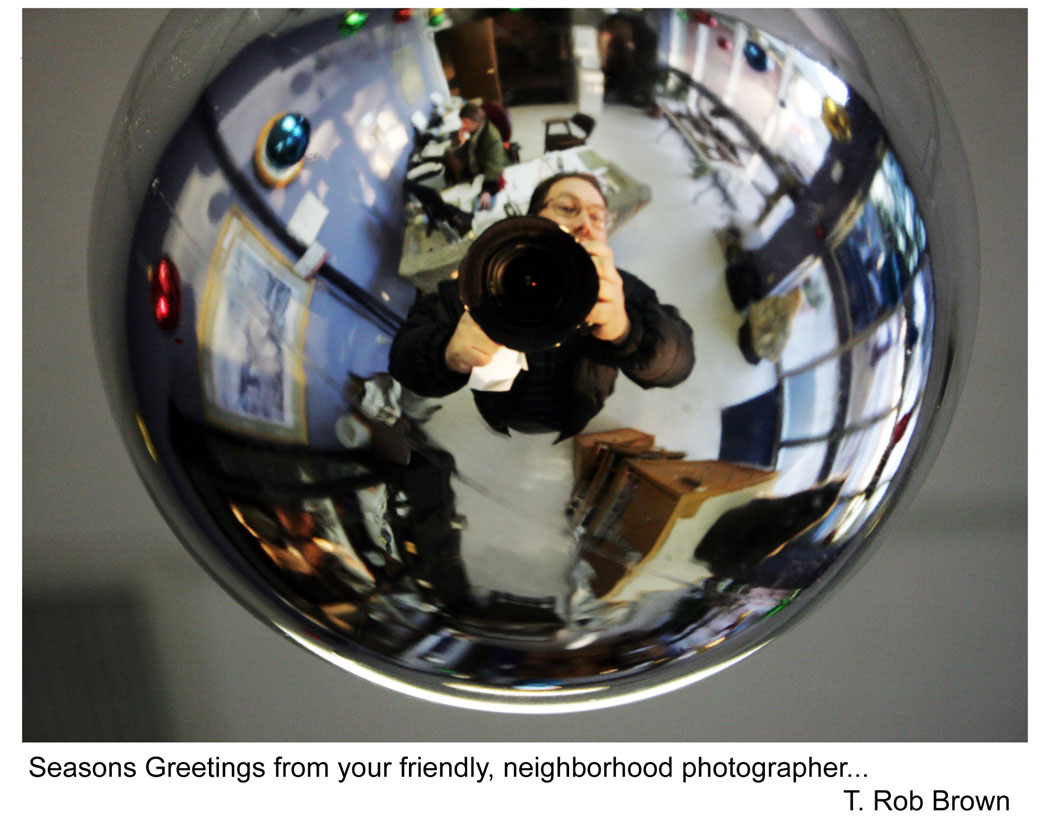 Here's something that made me smile, even though I hate this time of year (I know, I know, call me Scrooge). It's a holiday self-portrait from T. Rob Brown, my friend and former colleague at The Joplin Globe. I worked with Brown for many years at the Globe, and he often accompanied me on several investigative pieces. He was named AP Photographer of the Year for 2009. The holiday greeting wasn't taken with a fisheye, by the way -- it's his reflection in a Christmas ornament.

Wednesday, December 9, 2009
All in the lead
This, from CNN today: "President Obama -- fighting wars in two countries -- will arrive in Norway on Thursday to accept the Nobel Peace Prize for 2009."
Subscribe to:
Posts (Atom)